The Nicene Creed: Part Five
“For us men and for our salvation He came down from Heaven …”
“For us men and for our salvation He came down from Heaven …”
Here it is! Here is the reason Jesus came down from Heaven and was born into our world: It is what we call the “Incarnation,” the embodiment of God in the human form of Jesus. It was solely for our salvation. (Homework! Read John 3:16.) With the Original Sin of our first parents we lost our innocence, our intimate relationship with God. Because of this, we needed some way to repair the barrier that had come between us and God. Since we, as humans, creatures of God, could not save ourselves from sin and regain His grace, God became human. Jesus, Who is divine, was the only one Who could restore the unity between God and mankind.
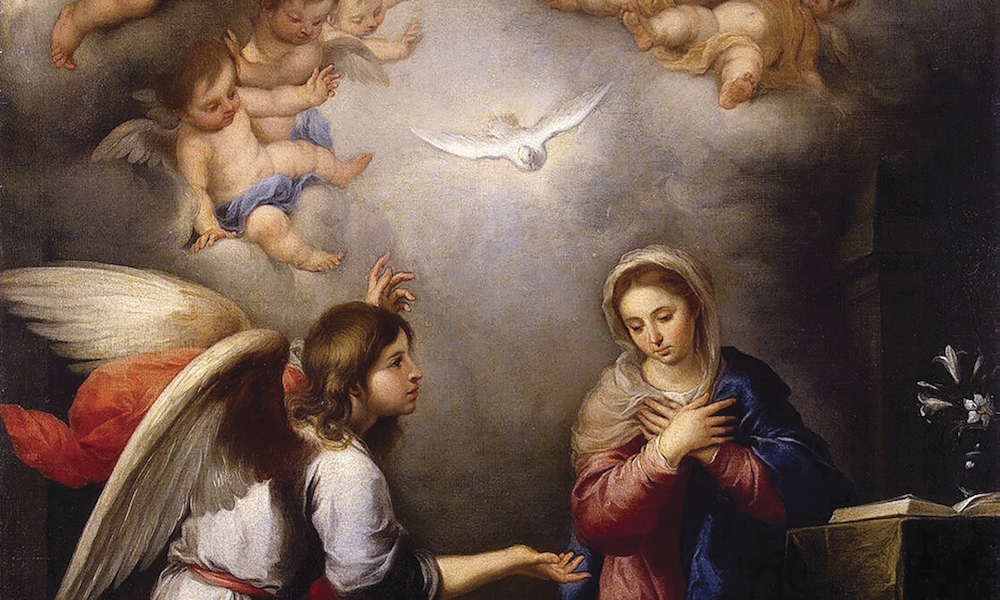
“… and by the Holy Spirit was incarnate of the Virgin Mary and became man.”
This statement is packed full of theological meaning, which I will attempt to explain in only brief terms. But first, I would like to point out that when this line of the Creed is recited all should bow. This is because we want to show the deepest respect possible for what God has done for us. I implore you, don’t be shy! Whether everyone else bows or not you should show your respect and do so. This statement represents a pivotal moment in the salvation of mankind and we should be humbled!
Now, let’s look at the three important teachings of the Church in this line of the Creed.
- Jesus was conceived by the power of the Holy Spirit. There was no human father for Jesus, no sexual intercourse involved in His conception. It was an action on the part of God that allowed Mary to conceive Jesus in her womb.[i] (Homework! Read Luke 1:26-38.)
- “Incarnate of the Virgin Mary.” Incarnate literally means that God took on human form. He was conceived in the womb of the Virgin Mary and thus was fully human, while also retaining His full divinity. This statement rejected the teaching of some of the theologians of the time who said Jesus only “appeared” to be man. They contended that He didn’t actually assume a human nature. Jesus was born from the womb of His earthly mother, just as all humans are. (Homework! As a side note, research the Immaculate Conception of Mary, her perpetual virginity, and her sinless life in her role as the Theotokos, Mother of God.)
- The words “and became man” were added to emphasize that Jesus was fully human. This dispelled the erroneous ideas of the time that the Son of God only “dwelled” in Jesus and did not actually become man.
“For our sake He was crucified under Pontius Pilate, He suffered death and was buried …”
We just read that Jesus came down from Heaven for our salvation. Now, we are told how this was physically brought about. Notice that the point is made that it was for our sake, for our salvation that He suffered death and was buried. Notice also that His method of death, crucifixion, was emphasized. Crucifixion was one of the cruelest and most painful ways a person could be put to death. Why did Jesus have to suffer so much? The answer is in the Creed. It was for our sake. Jesus came to atone for our sins — to bring us back into the grace of God. We have already stated that we believe in God, the Father Almighty, so we must understand that we have sinned before the One God, the maker of Heaven and earth, the Almighty!
When Adam and Eve disobeyed God, it was an infinite offense. To make up for this, Christ had to suffer in a horrible manner. He had to offer the greatest act of love that could be given. Jesus died in the most horrible manner possible because that is how ugly sin is. His death was not only for those who were living at the time, but also for all those who would come after His death and resurrection.[ii]
Jesus suffered death and was buried. The point here is to show that Jesus Christ, the sinless One, submitted to the power of death in order to save us from eternal death and open up the gates of Heaven. (Homework! Read 1 Peter 3:18.)
By mentioning the Roman Governor Pontius Pilate, the Creed identifies the Passion and death of Jesus at a time in human history. The bishops wanted to make it clear that this occurred at a specific time and was not just some abstract event that may or may not have happened.
Notice that the Creed says nothing about Jesus’ ministry, His teachings, or His miracles. It is not because this was not felt to be important. Remember, a creed is a statement of belief or a statement of faith. The teachings of Christ were very much on the minds of those who wrote the Creed. Their purpose, however, was not to expound on Christ’s teachings, but to lay out the foundational beliefs of the Christian Church.
“… and rose again on the third day in accordance with the Scriptures.”
Now, the Creed moves from Jesus’ time on earth to His glorified state. Jesus was laid in the tomb on Friday afternoon, before nightfall, and rose after three days (parts of Friday, Saturday, and Sunday) in accordance with the Scriptures. In other words, as the Scriptures described.
As a side note: The Apostles’ Creed tells us that Jesus “descended into Hell.” The understanding of Hell was that of “Sheol,” also known as the underworld. This is where the souls of all the holy ones were detained until the gates of Heaven had been reopened. Jesus went there to set them free and open the doors of Heaven. It does not mean that He was punished in any way in what we refer to today as Hell.
We can read in Scripture the events that occurred after Jesus rose from the dead. (Homework! Read Luke, Chapter 24, and John, Chapters 20-21.) He was seen multiple times by His disciples. He talked with them, and they even ate meals with Him. This was to show them that He truly had risen from the dead and was not just a miraculous vision. (Visions don’t eat!)
By rising from the dead, Jesus has shown that death is not what it seems to be. It is the beginning of a new life for those who believe in His words and profess belief in Him.
In the next issue, we will look at the words, “He ascended into Heaven and is seated at the right hand of the Father.”
[i] Ibid
[ii] Ibid
Deacon Robert Long serves Our Lady of the Valley Catholic Parish in Birmingham. He was ordained to the permanent diaconate on Dec. 7, 2013, by Bishop Emeritus Robert Baker at the Cathedral of St. Paul. Excerpts from Deacon Long’s series on the Nicene Creed will be published in issues of the One Voice through the end of 2026. The following comprises the fourth installment of his eight-part series.