The Nicene Creed: Part 6
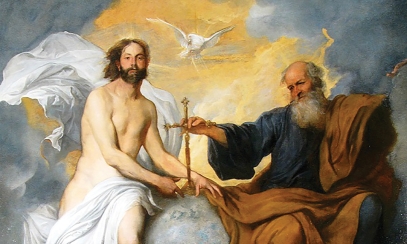
“He ascended into Heaven and is seated at the right hand of the Father.”
“He ascended into Heaven and is seated at the right hand of the Father.”
What does “ascended” into Heaven mean? This means that Jesus, under His own power, transferred His risen, glorified body into Heaven to be at the right hand of the Father. This signifies the beginning of the Messiah’s Kingdom, the Kingdom that will have “no end.” (Homework! Research the Assumption of Mary and note the difference between assumption and ascension.)
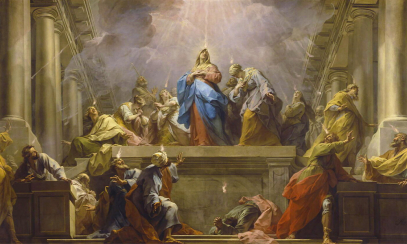
So, what happened between the time of Jesus’ Resurrection and His Ascension? The Gospels tell us that Jesus was with the Apostles for 40 days, preparing them to go out and bear witness to all that they had experienced while with Him. This led up to Pentecost, when the Holy Spirit descended upon them, and they went forth with no fear to proclaim the Gospel of the Lord. (Homework! Read Acts, Chapter 2.)
A side note. What is it with the number 40 in Scripture? It seems we see it all the time!
- The rain of the Great Flood (Noah) lasted 40 days and nights.
- Moses fasted for 40 days and nights to prepare himself to receive the Law.
- Moses was atop Mount Sinai for 40 days and nights receiving the Law.
- The Israelites wandered in the desert for 40 years after fleeing the Egyptians.
- The manna rained down on the Israelites for 40 years.
- The prophet Elijah walked 40 days and nights to reach the Mountain of God, Horeb.
- Jesus fasted for 40 days and nights to prepare for His public ministry.
- Jesus ascended into Heaven 40 days after His glorious Resurrection from the dead.
In Scripture, the number “40” signifies new life, new growth, transformation, a change from one great task to another great task, etc.
‘He will come again in glory …’
What does it mean that Jesus will come again in glory? Jesus came the first time in humility, to bring salvation to all mankind by sacrificing Himself for our sins. This was accomplished. Now, His second coming will involve judgement. This will be the end of human history as we know it. There will be no more Lords, no more revelations, no more Bibles, no more churches, no more saviors until the end of time. When will it happen? We don’t know. Even Jesus didn’t predict when this would occur. (Homework! Read Mark 13:32-33.) This is something that, as Christians, we should hope for and not fear.
“We must concern ourselves with living as if every day and hour may be our last on earth, so that we may be prepared to meet Jesus and be deemed worthy of enjoying eternity with Him.”i
‘… to judge the living and the dead and His Kingdom will have no end.’
The next lines of the Creed speak about something we don’t talk hardly at all about today: judgement. When we think of judgement, we usually think of it in a secular way, such as with criminal courts, but we should be honest about our God. Not only is He all-merciful, He is also just. “At the evening of life, we shall be judged on our love. And our love is a response to God’s love, which was given to us in Christ. Therefore, the standard at the final judgement is Christ. In the presence of Christ, Who is Truth itself, the truth of each man’s relationship with God will be laid bare.”ii (That causes me to shudder a little bit; how about you?)
The Church teaches that there will be two judgements: the particular judgement and the general judgement. The particular judgement takes place immediately following our death. Everything will be brought out and revealed before God. Each soul will receive a judgement that will result in one of three options: Heaven, Purgatory, or Hell. The general judgement takes place at the end of all time and history. This will hold no surprises for us, since we will have already undergone our particular judgement. The purpose of the last judgement is really to give glory to God by displaying His justice, wisdom, and mercy. Our whole lives, which may have seemed hard and cruel at times, will be unfolded before our eyes. We will know all the answers to our questions. We will all look forward to that day.iii
So, the scenario of final events is this: First, death; then, immediately, the particular judgement; then, either Hell, Purgatory as preparation for Heaven, or Heaven; then, at the end of time, the general judgement and the “new heavens and the new earth” for those who are saved.
Let’s step back for a moment and spend a little more time on the subject of Purgatory. For some reason, we don’t seem to talk about Purgatory as much as we did in the past. This is a shame because most of those who are destined for Heaven as their particular judgement will experience time in Purgatory. The existence of Purgatory logically follows from two distinct facts: our imperfection on earth and our perfection in Heaven. There has to be a transition between the two. This is Purgatory.
At the moment of our death, most of us will not be completely sanctified (purified, made holy), even though we are justified and are destined for Heaven (if we have not rejected Heaven through our un-repented sins). But to enter Heaven, we must be perfectly sanctified; we must be totally cleansed of whatever imperfections that stand between the soul and God. Only those who are perfect can be in the presence of God.iv This final process of purification is what we call Purgatory. It is God’s loving parental discipline. (Homework! Read Hebrews 12:5-11.)
While in Purgatory, the soul experiences the pain of being delayed from its total union with God (what the Church calls the Beatific Vision). The soul in Purgatory does not want to appear before God in its present state, but it has joy and hope in the knowledge of what is to come (it knows it is destined for Heaven). How long does this time in Purgatory last? No one knows this except God. Besides, time, as we know it, will not be the same in Purgatory.v
It is believed that the soul, once in Purgatory, cannot shorten its sufferings, but we who are living can, with God’s great mercy, assist the souls in Purgatory with our prayers and sacrifices. This is why we offer Masses for our loved ones who have died. This reveals the Church’s belief that we are not cut off from those who have gone before us. We are still linked together in what we call the Communion of Saints, the family of God. Bottom line — Purgatory is a good thing, because those who are undergoing this process know that they are on their way to Heaven.vi
(Homework! Research indulgences as related to Purgatory.)
In the next issue, we will look at the words, “I believe in the Holy Spirit, the Lord, the giver of life …”
[i] Ernst, Part II
[ii] Catechism of the Catholic Church, 1022,1039
[iii] Ernst, Part II
[iv] Revelation 21:27
[v] Ernst, Part III
[vi] Ibid
Deacon Robert Long serves Our Lady of the Valley Catholic Parish in Birmingham. He was ordained to the permanent diaconate on Dec. 7, 2013, by Bishop Emeritus Robert Baker at the Cathedral of St. Paul. Excerpts from Deacon Long’s series on the Nicene Creed will be published in issues of the One Voice through the end of 2026. The following comprises the fourth installment of his eight-part series.