‘The crib he made’
St. Francis and the Nativity
St. Francis and the Nativity
Some readers might remember several issues this year in which mention of St. Francis of Assisi being credited with the creation of the first-ever Nativity was made. As we come to the close of the Jubilee Year of St. Francis of Assisi and prepare to celebrate the Solemnity of the Nativity of the Lord, it is fitting to share the story of “the crib he made.”
Some readers might remember several issues this year in which mention of St. Francis of Assisi being credited with the creation of the first-ever Nativity was made. As we come to the close of the Jubilee Year of St. Francis of Assisi and prepare to celebrate the Solemnity of the Nativity of the Lord, it is fitting to share the story of “the crib he made.”
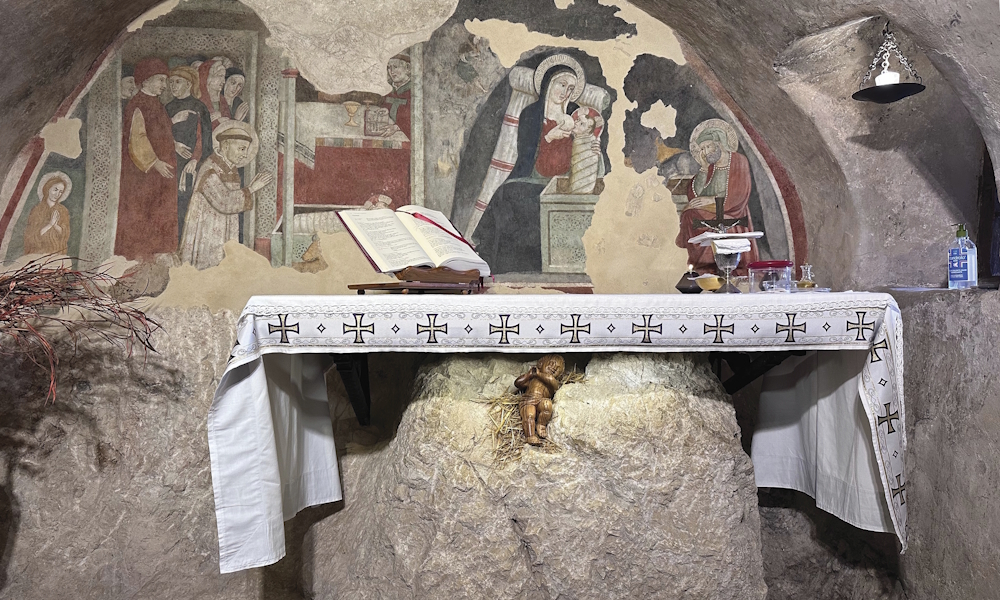
St. Francis traveled to Egypt in mid-1219. From there, he went to the Holy Land, before returning to Italy in the early summer of 1220. The experience of having seen the sites of Jesus’ birth, life, death, and resurrection stayed with the saint. A little over three years later, St. Francis was in Rome awaiting confirmation of his Rule from Pope Honorius III, which he received on Nov. 29, 1223. On his way back to Assisi from Rome, he stopped at Greccio, a small town about 45 miles north of Rome. He was familiar with the town and its people, and it is believed the town’s outlying terrain reminded him of his travels to the Holy Land.
According to the work First Life, a biography of sorts written in 1228 by Brother Thomas of Celano at the command of Pope Gregory IX, two weeks before Christmas St. Francis sent for Giovanni Velita, a Greccio resident and humble nobleman. Of the exchange, Celano records St. Francis saying: “If you would like to celebrate the Lord's birthday with me at Greccio, go there ahead of me and be sure to get things ready as I tell you. I want to keep the memory of the Child's birth in Bethlehem in such a way that I can somehow see before me the hardships of His infancy, see the Babe lying in the manger on the hay where He was laid, with the ox and the ass standing by.”
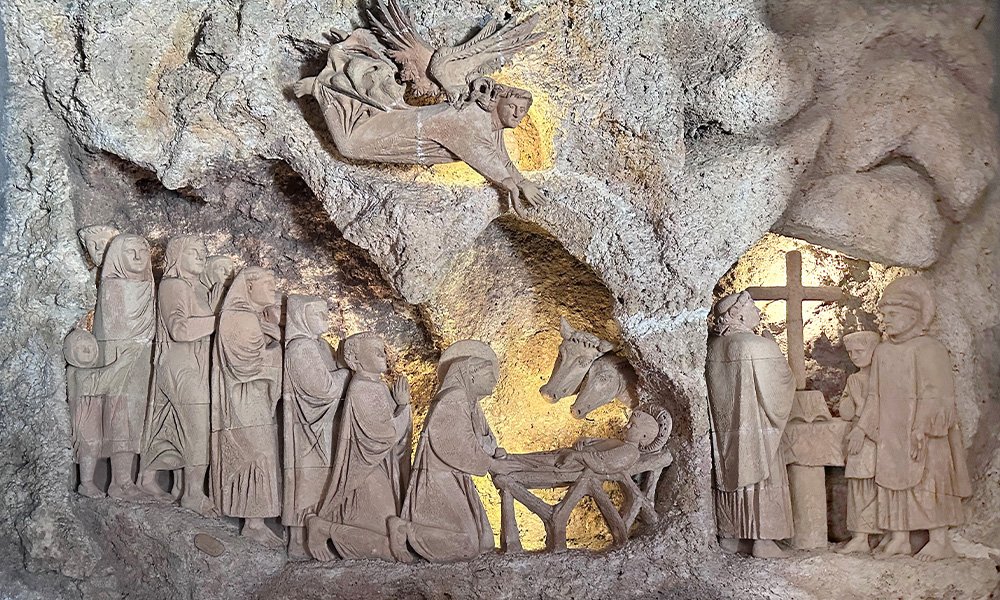
Velita did as he was asked, and Celano notes that when St. Francis arrived, he was “delighted to find everything ready.” A manger filled with hay and an ox and an ass standing beside. “There, simplicity was honored, poverty exalted, humility glorified,” continues Celano. “Greccio became, as it were, a new Bethlehem.”
Friars were summoned from various communities to the “new Bethlehem,” and the men and women of Greccio prepared candles and torches. As Midnight Mass began, Celano chronicles: “The night was made as bright as day … The woods resounded with voices, the rocks echoed back the sounds of rejoicing … and the whole night rang with sounds of jubilation.”
As a deacon, St. Francis “chanted the Gospel with sonorous voice” and preached the homily. Then, the priest celebrated the Holy Eucharist over the manger. The joy of the night was accompanied by another gift: a miraculous vision. Celano, as well as St. Bonaventure, in his work, The Life of St. Francis of Assisi, written around 1260, both document the vision. The man, writes St. Bonaventure, declared he saw a sleeping child appear in the once-empty manger, “Who seemed to be awakened from sleep when the blessed Father Francis embraced Him in both arms.” The two also reference miracles attributed to the hay of the manager.
For the people of Greccio, St. Francis’ Nativity scene made the Incarnation real: it was simple and powerful. Almost eight centuries after that night in Greccio, Pope Francis, in 2019, traveled to the small town to address the meaning and importance of that simple power with the signing of his apostolic letter Admirabile Signum. “The Nativity scene,” writes the pope, “is like a living Gospel rising up from the pages of sacred Scripture.” The pope notes that setting up the Christmas crèche helps us to “relive the history of what took place in Bethlehem.” “From the time of its Franciscan origins,” he continues, “the Nativity scene has invited us to ‘feel’ and ‘touch’ the poverty that God’s Son took upon Himself in the Incarnation. … (T)he Christmas crèche is part of the precious yet demanding process of passing on the faith. Beginning in childhood, and at every stage of our lives, it teaches us to contemplate Jesus, to experience God’s love for us, to feel and believe that God is with us and that we are with Him.”