Commemoration of Father James E. Coyle
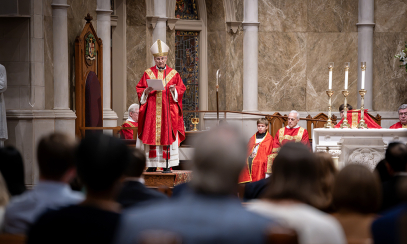
On Aug. 11, Bishop Raica celebrated Mass at the Catedral of St. Paul, commemorating the anniversary of Father James E. Coyle’s murder in 1921. The complete text of the bishop’s homily follows herein.
On Aug. 11, Bishop Raica celebrated Mass at the Catedral of St. Paul, commemorating the anniversary of Father James E. Coyle’s murder in 1921. The complete text of the bishop’s homily follows herein.
My brothers and sisters, every year on this date, two flames meet on our liturgical calendar. The universal Church remembers a poor woman of Assisi who would not look away from Christ. And our local Church, embracing both the Archdiocese of Mobile and the Diocese of Birmingham, remembers a priest who would not look away from his people. St. Clare's feast and the anniversary of Father James Coyle's martyrdom fall on the very same day, Aug. 11, and once you notice that, you cannot unsee it. It is why we borrow her readings for him. It is fitting, because both of them, in their own centuries and their own ways, were "found in Christ" at the cost of everything else.
"I have come to consider everything as a loss because of the supreme good of knowing Christ Jesus my Lord... I have accepted the loss of all things, and I consider them so much rubbish, that I may gain Christ." (Phil 3:8)
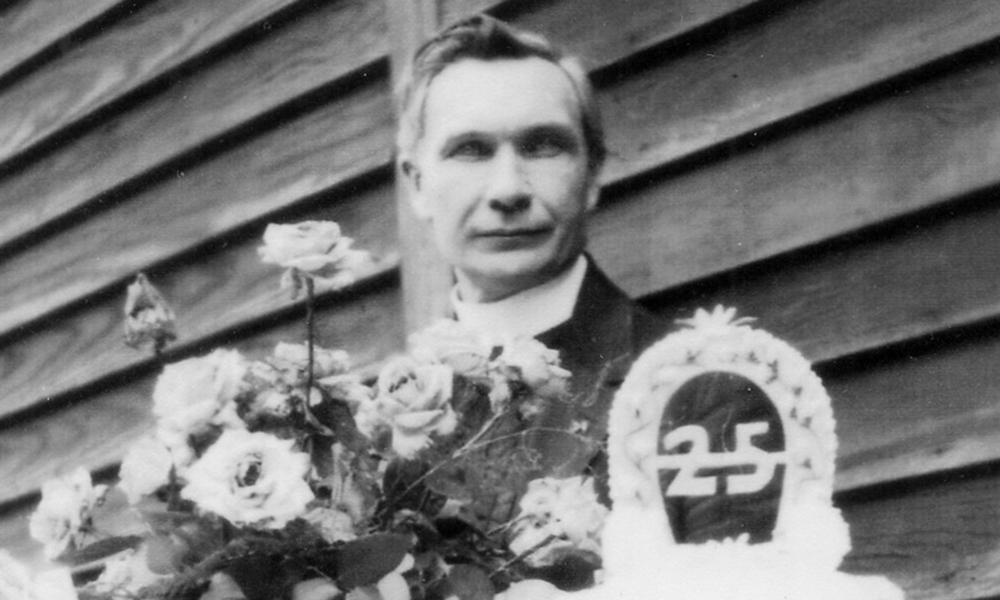
Father Coyle could have preached that line to himself on the evening of Aug. 11, 1921. He was sitting on the rectory porch of St. Paul's, praying his breviary, having just witnessed the marriage vows of Ruth Stephenson, a young convert to Catholicism, to Pedro Gussman, a Puerto Rican Catholic. It was a marriage that offended nothing but the prejudice of the age. Within two hours, Father Coyle was shot by the bride's father, Rev. Edwin Stephenson, an enraged Methodist minister, and dead within the hour at St. Vincent's hospital. A grand jury barely indicted the killer. A jury that reportedly included Klansmen, defended by a young lawyer named Hugo Black, acquitted him on a plea of temporary insanity. By the world's ledger, justice failed. By the ledger St. Paul kept – “I have accepted the loss of all things, that I may gain Christ” - nothing was lost at all.
That is the strange arithmetic of the saints. It is St. Clare's arithmetic too: she slipped out of her father's house at eighteen to kneel before Francis and be clothed in sackcloth, trading a noble inheritance for a bare floor and a full heart. It is the arithmetic of the Gospel we just heard: "Everyone who has given up houses or brothers or sisters or father or mother... for the sake of My name will receive a hundred times more, and will inherit eternal life." (Mt 19:29) Father Coyle gave up nothing on impulse. He had been giving himself away for years: in his parish, in his columns for The Birmingham Newsand The Birmingham Age-Herald patiently explaining Catholic teaching to a city that had been taught to fear it, in his quiet insistence that a Puerto Rican man, an Irish immigrant's flock, and a young convert all belonged equally at God's altar. The porch simply finished what a lifetime of small, faithful acts had already begun.
A heart that would not harden
We are keeping this commemoration in a year the Church has set aside for the Sacred Heart of Jesus. I cannot think of a better lens for Father Coyle. Birmingham in 1921 was a city organized, in part, around fear of the different: the Klan and the "True Americans" made a program of it, and the Diocese of Mobile itself had been warned of plots against the priest and against St. Paul's. It would have been so reasonable for a pastor under that kind of pressure to grow guarded, to keep his people's heads down, to preach safety instead of charity. Father Coyle did the opposite. He officiated at the wedding anyway. He kept writing his defenses of the faith in the daily papers anyway, over his own signature, where anyone with a grudge could find him. That is what a heart formed on the Sacred Heart looks like under pressure: it does not calcify, it does not retaliate, and it does not stop loving the very people who despise it. Bishop Edward Allen of Mobile said it best two days after the murder, calling him simply a "martyr to duty."
Dialogue, encounter, and the poor man of Assisi
This is also, of course, a year we hold up St. Francis of Assisi, the saint of fratelli tutti – brothers and sisters all, of universal brotherhood, of walking toward the stranger instead of building a wall against him. Father Coyle's whole ministry, and his death, sit exactly on that Franciscan axis. He did not win Birmingham's respect for Catholics by winning an argument or a trial. The trial, in fact, he lost. He won it by refusing, at the cost of his life, to treat any person, Irish or Puerto Rican, cradle Catholic or convert, "true American" or immigrant, as anything less than a child of God worthy of the sacraments. Encounter and dialogue were not soft virtues for him; they were the very thing that got him killed, and the very thing that, in the long run, changed his city. Historians looking back, Dr. Sharon Davies among them in her historical chronicle entitled Rising Road, clearly note that the shock of his murder helped turn the tide of public opinion against Klan violence in Alabama. Father Coyle did not live to see that turn. We are still living inside the dynamics of it, acknowledging its slow and steady progress.
Our patrons, his companions
It is worth remembering, too, that Father Coyle stands beside our own diocesan patrons rather than apart from them. Like St. Paul, he was an unashamed public apologist, a man who would rather explain the faith in the local newspaper, in plain sight of his critics, than let error stand unanswered. Like St. John Vianney, his priesthood was built on unglamorous fidelity: frequent Communion urged from the pulpit, devotion to Our Lady fostered among ordinary working families, a parish loved in the small daily ways long before it was ever tested in the extraordinary one. Sanctity, for both of them, was rehearsal before it was heroism.
Why we keep this day
His cause, which we pray one day will mature, is still young, still being studied, still growing quietly the way these things do. We do not commemorate him today because Rome has spoken. We commemorate him because a city that once could not protect him now cannot stop remembering him, and because his witness still answers a question every generation of Alabama Catholics has to answer again: when love of neighbor costs something, will we still extend it?
St. Clare spent her whole religious life gazing at Christ so intently that she came to resemble him. Father Coyle spent his priesthood gazing at his people, all of them, so faithfully that he was willing to die rather than turn that gaze away. May we, gathered here in central and northern Alabama a century later, ask for that same undivided sight.
Eternal rest grant unto him, O Lord. And may the soul of Father James Coyle, through the mercy of God, rest in peace! Amen.