‘You are my inheritance, O Lord’
Memorial of St. Francis of Assisi
Memorial of St. Francis of Assisi
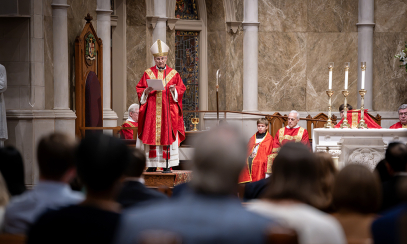
On Oct. 4, Bishop Raica celebrated Mass at the Cathedral of St. Paul, marking the memorial of St. Francis of Assisi and recalling the 800th anniversary of the saint’s death. The complete text of the bishop’s homily follows herein.
On Oct. 4, Bishop Raica celebrated Mass at the Cathedral of St. Paul, marking the memorial of St. Francis of Assisi and recalling the 800th anniversary of the saint’s death. The complete text of the bishop’s homily follows herein.
My brothers and sisters in Christ, today we recall the 800th anniversary of the death of St. Francis of Assisi, who died in 1226 at the age of 46, in the special jubilee year to help us “become a model of holiness of life and a constant witness of peace.”
Imagine a young man in the square of Assisi, the son of a wealthy cloth merchant, with fine clothes, good prospects, a bright future with every door open to him. Before his father, the local bishop, and the whole town, he takes off those clothes and hands them back to his father. Then he stands there with nothing.
The crowd must have thought he had lost his mind, but Francis had not lost anything. He had found the one thing that cannot be lost. Throughout his life as a mystic, a poet, and a friar, he began to demonstrate to the world the power of the Gospel to transform one’s life into something noble and good by his reliance on God’s providence and simplicity of life.
Today's readings tell us the goal. In Deuteronomy, the tribe of Levi is set apart for the Lord's service and receives no land among their brothers. Why? "The Lord Himself is his heritage (inheritance)." And the psalmist, centuries later, sings the same truth: "You are my inheritance, O Lord." Francis lived that verse more literally than almost anyone in history. He had no land and no wealth, only God. We might conclude he was extreme, but he was not an extremist as we use the term pejoratively today. In having only God before him, he discovered he had everything.
Most of us are not called to renounce all of our possessions in a town square, at Railroad or Linn Park, but we all know how much we are carried along by what we own and what we fear to lose. Francis shows us another way to live, with open hands. When God is our inheritance, we can afford to be more generous, to be more forgiving, and to risk loving even more.
But St Francis did not strip himself of everything in order to do nothing. In the town of Assisi, there was a little church of San Damiano down the hillside, crumbling and nearly forgotten. Kneeling before the crucifix there, Francis heard the words: "Francis, rebuild My church." At first, he took it literally and carried stones, one by one, to repair a ruined chapel. Only later did he understand that the Lord meant something larger in scope. His ultimate aim was to set out and rebuild the whole Church, the living Body of Christ.
Here is the beautiful balance of his life. We can say that his life and witness show that the Church is rebuilt from the inside and from the outside. Francis gave us the brothers, who went out onto the roads to serve the poor, to preach, and to heal. He gave us Clare and her sisters, who now stay within the walls of the Church of St. Clare and held up the whole world in devoted prayer. Neither gift is complete without the other. The Church needs hands that serve and hearts that pray. If we serve without prayer, we grow tired and bitter. If we pray without serving, our prayer grows small focused more myopically on ourselves. The rebuilding begins in the quiet of the heart and overflows into the street to say that life has something more to offer. Here in our diocese, we have the witness of the Franciscan Friars of the Eternal Word, the Sister Servants, the Poor Clare nuns at the Shrine in Hanceville, and the Brothers of the Poor of Jesus Christ who minister downtown here with the homeless and street people. How grateful we are that witness of St. Francis also touches our diocese with dedicated disciples of Christ. At the same time, we have several parishes named after St. Francis in Bessemer, Talladega, Livingston, and the University Parish in Tuscaloosa.
What did Francis want that rebuilt Church to proclaim? Paul tells us in Galatians: "Far be it from me to boast except in the cross of our Lord Jesus Christ." Francis took those words to heart. Two years before his death, on a lonely mountain village called La Verna, he received in his own body the marks of the Lord's passion: the stigmata. Paul writes, "I bear the marks of Jesus on my body," and Francis could say it as well. His love for the story of our salvation was so deep that it became visible as a gift of God.
Yet, in spite of the lack of modern means of communication, notice how St. Francis made the Gospel understandable and alive. In the winter of 1223, at Greccio, he gathered the villagers around a manger scene with hay, an ox, and a donkey taken from the Gospels of Luke and Matthew. He wanted people to see with their own eyes, before the advent of the printing press which occurred some 200 years later and made Bibles increasingly more available, the Gospel story of the Nativity of our Lord come to life. There, they saw the poverty and tenderness of God made flesh. Our Christmas cribs, in homes and churches around the world, are attributed to his legacy – and we should have them in a prominent place in our homes during the Christmas season to remind us of the story of God’s love.
The Franciscans, currently entrusted with the oversight and care of the holy places in Jerusalem, help to maintain these sacred sites for pilgrims, especially the devotion of the Way of the Cross during Lent. Francis understood that no one should have to be a scholar to know that God became one of us, and that He loved us all the way to the cross. That way of the cross is here on the walls of our Cathedral and all of our churches and chapels.
This brings us to the Gospel. Jesus prays: "I give You praise, Father, Lord of Heaven and earth, because You have hidden these things from the wise and the learned and revealed them to the childlike." St. Francis was never a great theologian, and he never became a priest. He remained a deacon, one who serves, yet he saw what many of the wise missed, that Christ is truly here, in the Eucharist and in every person we meet. God did not remain far away. He has a face, and it just may be the face of the person sitting beside you.
Francis' vision reached even further. He called the sun his brother and the moon his sister – “brother sun and sister moon.” In his Canticle of Creation, he noted that all creation sings with us in praise of God. Long before anyone spoke of ecology, Francis knew that our planet earth is not ours to exploit but a gift to be received with reverence. When we care for our common home, we are rebuilding the Church too, because we honor the Creator by honoring what He made or created for us.
And so today, in a world that feels fractured, with so much division, so much noise, and so much fear, thousands still walk the hills of Umbria to Assisi searching for an experience of the divine. He appeals to almost every religious tradition, ecumenical and interreligious. His themes of ministry are noted and studied even by secularists and agnostics, yet, many find their way to Assisi. They come, believers and seekers alike, from every nation and every tradition. Why? Because in that quiet town they sense an extraordinary place of beauty and peace. For those with open minds and hearts, the peace experienced there is not a fantasy. It is what happens when people come to experience, not our loneliness, but an experience of the divine here on earth where brother and sister are an integral part of an interrelated and interlocking community seeking the highest ideals fostered by man whose inheritance rested in God.
Then Jesus' last words in today's Gospel become ours: "Come to Me, all you who labor and are burdened, and I will give you rest. Take My yoke upon you... for My yoke is easy, and My burden light." Joy was the mark of his life. He was a troubadour of God, singing God’s praises and helping to open minds and hearts to the love of God among us.
So, this October, on this feast day of St. Francis, may we ponder that gift. The Lord died and rose for us. Each time we choose the Gospel, each time we see Christ in one another, and each time we love without counting the cost, the Church is rebuilt, stone by stone, person by person.
St. Francis, pray for us. Help us to hold less and love more, so that in us, too, the Lord may rebuild His Church in and around us. And may we, like you, be true instruments of His peace. After all, “You are my inheritance, O Lord!” Amen.