The ‘unfathomable abyss’ of the Lord’s mercy
‘On the cross, the fountain of My mercy was opened wide by the lance for all souls-no one have I excluded!’
‘On the cross, the fountain of My mercy was opened wide by the lance for all souls-no one have I excluded!’
On April 30, 2000, Pope St. John Paul II canonized Sister Maria Faustina Kowalska of the Blessed Sacrament, an uneducated, Polish religious sister belonging to the Congregation of Sisters of Our Lady of Mercy who had visions of Christ which inspired the Divine Mercy devotion.
On April 30, 2000, Pope St. John Paul II canonized Sister Maria Faustina Kowalska of the Blessed Sacrament, an uneducated, Polish religious sister belonging to the Congregation of Sisters of Our Lady of Mercy who had visions of Christ which inspired the Divine Mercy devotion.
In 1926, at the age of 20, the young Kowalska entered the convent and was given the name Maria Faustina. In February of 1931, the Lord appeared to her clothed in a white garment with His right hand raised and two rays emanating from His Sacred Heart.
Sister Faustina documented the Lord as saying, “Mankind will not have peace until it turns with trust to My mercy.” (Diary of St. Faustina, 300). In the most simplest of terms, the message of the Divine Mercy, given to us by St. Faustina, instructs the faithful to trust in His mercy, receive it, then share with others.
For seven years, until she succumbed to tuberculosis at the age of 33 on Oct. 5, 1938, the Lord continued to appear to St. Faustina. Included in the many apparitions were elements of the devotion practiced today, including the feast, image, novena, chaplet, and hour of great mercy.
Feast
“I desire that the feast of Mercy be a refuge and shelter for all souls, and especially for poor sinners. On that day the very depths of My tender mercy are open. I pour out a whole ocean of graces upon those souls who approach the fount of My mercy. The soul that will go to Confession and receive Holy Communion shall obtain complete forgiveness of sins and punishment. On that day, all the divine floodgates through which grace flows are opened. …” (699)
On the day of her canonization, Pope St. John Paul II designated the Second Sunday of Easter as Divine Mercy Sunday, making it a feast day in the General Roman Calendar.
Image
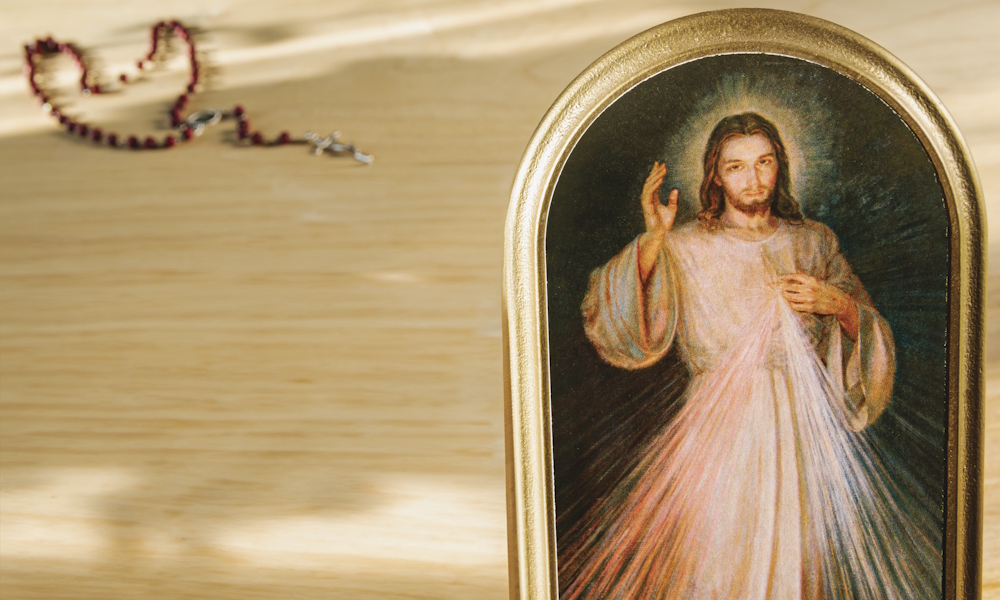
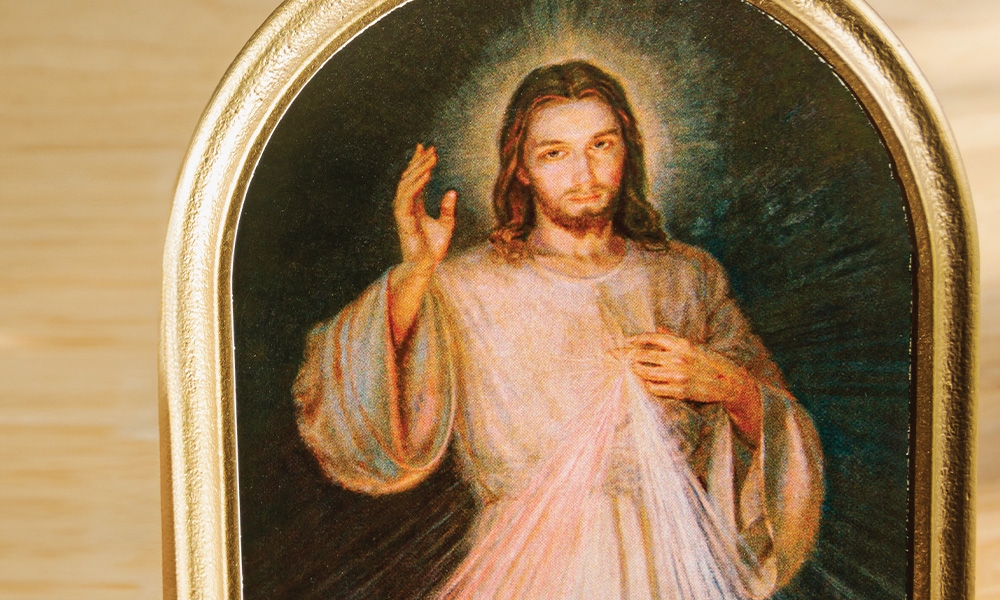
“Paint an image according to the pattern you see, with the signature: Jesus, I trust in You. … I promise that the soul that will venerate this image will not perish. I also promise victory over enemies already here on earth, especially at the hour of death. I Myself will defend it as My own glory. (47-48)
With the help of her confessor, Father Michael Sopoćko, a Polish realist painter, Eugeniusz Marcin Kazimirowski, was commissioned to paint the first image of the Divine Mercy, which was completed in 1934. In 1943, another Polish artist, Adolf Hyla, painted the image as a gift of thanksgiving for his family’s survival during World War II. Due to Soviet possession of the original, Hyla’s version was reproduced widely and became the more familiar image. Since that time, though, countless images have been created for veneration.
The image depicts Jesus moving toward the viewer with His merciful love in the form of two rays: one pale and one red, signifying the graces of baptism and the Eucharist.
Novena of Chaplets
“I desire that during these nine days you bring souls to the fount of My mercy, that they may draw therefrom strength and refreshment and whatever graces they need in the hardships of life and, especially, at the hour of death. On each day, you will bring to My Heart a different group of souls, and you will immerse them in this ocean of My mercy, and I will bring all these souls into the house of My Father. ” (1209)
A novena usually consists of nine consecutive days of prayer leading up to a feast day. While the novena can be said at any time throughout the year, it is customary to begin the Divine Mercy Novena of Chaplets on Good Friday. For each of the nine days, the Lord requested a different intention: all mankind, especially sinners; the souls of priests and religious; all devout and faithful souls; those who do not believe in God and those who do not yet know Jesus; the souls who have separated themselves from the Church; the meek and humble souls and the souls of little children; the souls who especially venerate and glorify His mercy; the souls detained in purgatory; and souls who have become lukewarm.
Hour of great mercy
“At three o’clock, implore My mercy, especially for sinners; and, if only for a brief moment, immerse yourself in My Passion, particularly in My abandonment at the moment of agony. This is the hour of great mercy. In this hour, I will refuse nothing to the soul that makes a request of Me in virtue of My Passion.” (Diary, 1320)
3 O’clock prayer
You expired, Jesus, but the source of life gushed forth for souls and the ocean of mercy opened up for the whole world. O Fountain of Life, unfathomable Divine Mercy, cover the whole world and empty Yourself out upon us. O Blood and Water which gushed forth from the Heart of Jesus as a Fountain of Mercy for us, I trust in You! Holy God, Holy Mighty One, Holy Immortal One, have mercy on us and the whole world. (3 times) Jesus, King of Mercy, we trust in You!
Chaplet of the Divine Mercy
“The souls that say this chaplet will be embraced by My mercy during their lifetime and especially at the hour of their death.” (754)
The chaplet is prayed on ordinary rosary beads and can be prayed at any time with the most common being during the novena. However, it is especially appropriate to pray following the reception of Holy Communion, during the Hour of Great Mercy, and for a dying person.
- Make the Sign of the Cross
- Optional Opening Prayers
- You expired, Jesus, but the source of life gushed forth for souls, and the ocean of mercy opened up for the whole world. O Fount of Life, unfathomable Divine Mercy, envelop the whole world and empty Yourself out upon us.
- (repeat three times)
- O Blood and Water, which gushed forth from the Heart of Jesus as a fount of mercy for us, I trust in You!
- Our Father
- Hail Mary
- The Apostles’ Creed
- The Eternal Father
- Eternal Father, I offer You the Body and Blood, Soul and Divinity of Your Dearly Beloved Son, Our Lord, Jesus Christ, in atonement for our sins and those of the whole world.
- For the sake of His sorrowful Passion
- For the sake of His sorrowful Passion, have mercy on us and on the whole world.
- Repeat for the remaining decades
- Saying the "Eternal Father" (6) on the "Our Father" bead and then 10 "For the sake of His sorrowful Passion" (7) on the following "Hail Mary" beads.
- Conclude with Holy God (repeat three times)
- Holy God, Holy Mighty One, Holy Immortal One, have mercy on us and on the whole world.
- Optional Closing Prayers
- Eternal God, in Whom mercy is endless and the treasury of compassion — inexhaustible, look kindly upon us and increase Your mercy in us, that in difficult moments we might not despair nor become despondent, but with great confidence submit ourselves to Your holy will, which is Love and Mercy itself. Amen.