‘A new declaration of love’
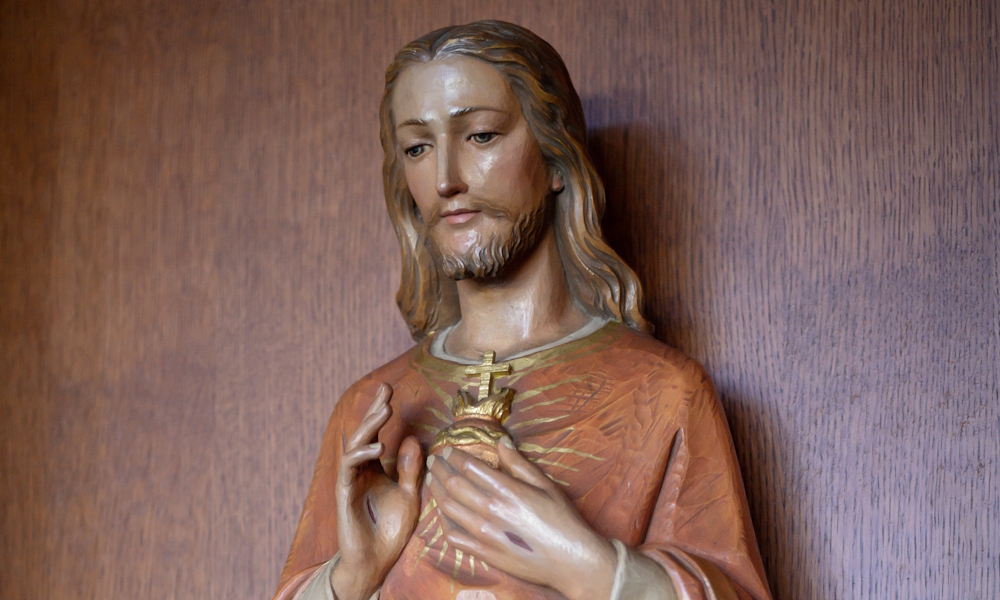
The Most Sacred Heart of Jesus
The Most Sacred Heart of Jesus
July 4, 2026, will mark the 250th anniversary of the signing of the Declaration of Independence. The celebration of the event that is largely considered to be the “birthday” of our country will be marked with commemorations and celebrations throughout these 50 states. For Christian believers, the celebrations are an occasion to remember that the freedoms we enjoy are destined to help us freely choose the good, to love God above all things, and to love our neighbors as ourselves. As well, it is a time for prayer for our country. The U.S. Bishops announced that this special anniversary will be celebrated by consecrating the United States to the Sacred Heart of Jesus in June of this year. But why is the Sacred Heart such a powerful devotion, and what does it mean to consecrate a nation to it?
July 4, 2026, will mark the 250th anniversary of the signing of the Declaration of Independence. The celebration of the event that is largely considered to be the “birthday” of our country will be marked with commemorations and celebrations throughout these 50 states. For Christian believers, the celebrations are an occasion to remember that the freedoms we enjoy are destined to help us freely choose the good, to love God above all things, and to love our neighbors as ourselves. As well, it is a time for prayer for our country. The U.S. Bishops announced that this special anniversary will be celebrated by consecrating the United States to the Sacred Heart of Jesus in June of this year. But why is the Sacred Heart such a powerful devotion, and what does it mean to consecrate a nation to it?
“We have come to believe …” (John 6:69)
A brief history of devotion to the Sacred Heart
Throughout the history of the Church, we see men and women drawn to the Heart of Jesus, especially in moments of distress and difficulty, learning to endure hardships with hope in the fulfillment of God’s promises. Devotion to the Sacred Heart can be traced back to the Last Supper. Jesus had just announced that one of His disciples would betray Him, and, as the disciples are shocked and confused by this statement, St. John the Evangelist laid his head close to the Heart of Jesus, becoming a model of prayer in difficult moments. (Jn 13:23) We learn to know Jesus and the great love that He shares with us in silently drawing close to His Heart in prayer. Devotion to the Sacred Heart of Jesus began to spread widely in the 13th century. St. Bonaventure several times wrote about the Heart of Jesus as a symbol of the love of God, since by looking at images of the Heart of Jesus we are reminded that God loved us so much that He gave His only Son to die for our sins. The Sacred Heart of Jesus is not an idea but a tangible image of the lengths that God is willing to go to reconcile us to Himself.
Yet it was perhaps through the life of the humble Visitation nun, St. Margaret Mary Alacoque, that devotion to the Sacred Heart, as we know it today, took shape in what Pope Francis referred to as “a new declaration of love.” (Dilexit nos, 119) The practice of going to confession and receiving Communion on First Friday is drawn from apparitions of our Lord to St. Margaret Mary, during which our Lord promised many graces for those who practice devotion to the Sacred Heart on First Friday, particularly the grace of repentance at the end of their lives. Celebrating the Sacred Heart on First Friday, by God’s grace, transforms our hearts to be more like His Heart so that, at the end of our lives, His love has transformed us into people who long to live in the fullness of that love forever. Even today, many parishes throughout our diocese offer special times for confession, Mass, and Eucharistic adoration on the First Fridays of each month. Going to confession and Mass on First Friday is an act of love that we make in response to the love that Christ has shown us. Further, the practice of making a “Holy Hour” also sprung up from these same apparitions of our Lord to St. Margaret Mary, and many parishes continue this devotion through Eucharistic adoration on the First Fridays of each month. I remember when I was serving as the parochial vicar at Holy Spirit in Huntsville, there was never a break in the confession line on First Friday!
In 1899, responding to letters from many people throughout the world, Pope Leo XIII consecrated the whole human race to the Sacred Heart of Jesus. In his encyclical Annum Sacrum, he wrote, “And since there is in the Sacred Heart a symbol and a sensible image of the infinite love of Jesus Christ which moves us to love one another, therefore is it fit and proper that we should consecrate ourselves to His most Sacred Heart — an act which is nothing else than an offering and a binding of oneself to Jesus Christ, seeing that whatever honor, veneration, and love is given to this divine Heart is really and truly given to Christ Himself.” (Annum Sacrum, 8) Devotion to the Sacred Heart of Jesus exploded throughout the world as a result. The writings of the popes have continued to use the image of the Sacred Heart as a point of reference for the love of God made visible, most recently in the encyclical Dilexit Nos, published by Pope Francis in 2024.
“And behold, I am with you always …” (Matthew 28:20)
The importance of devotion to the Sacred Heart today
The Sacred Heart reminds us of God’s infinite love and mercy. One of the temptations we can face in the spiritual life is to condemn ourselves. Bringing our sins and weaknesses to God and asking for His help is a necessary and beautiful part of our growth in holiness. However, we tend to take it too far. We can see our sins and weaknesses and, instead of bringing them to the Lord “whose mercy endures forever,” (Ps 136), we can use them as a motivation to think of ourselves as unlovable or that we have been forgotten by God. Indeed, a philosopher once succinctly described this reality: “man’s will to find himself guilty, and unredeemably so.” (Friedrich Nietzsche, The Genealogy of Morals, Chapter 22) By looking at images of and praying with the Sacred Heart of Jesus, we are reminded that Christ Jesus was sent by His Father not to wound or condemn, but to heal and save. “For God did not send His Son into the world to condemn the world, but that the world might be saved through Him.” (Jn 3:17) Thus, the Sacred Heart invites us to view ourselves within God’s plan of redemption and what He desires to give us instead of a self-condemnatory manner.
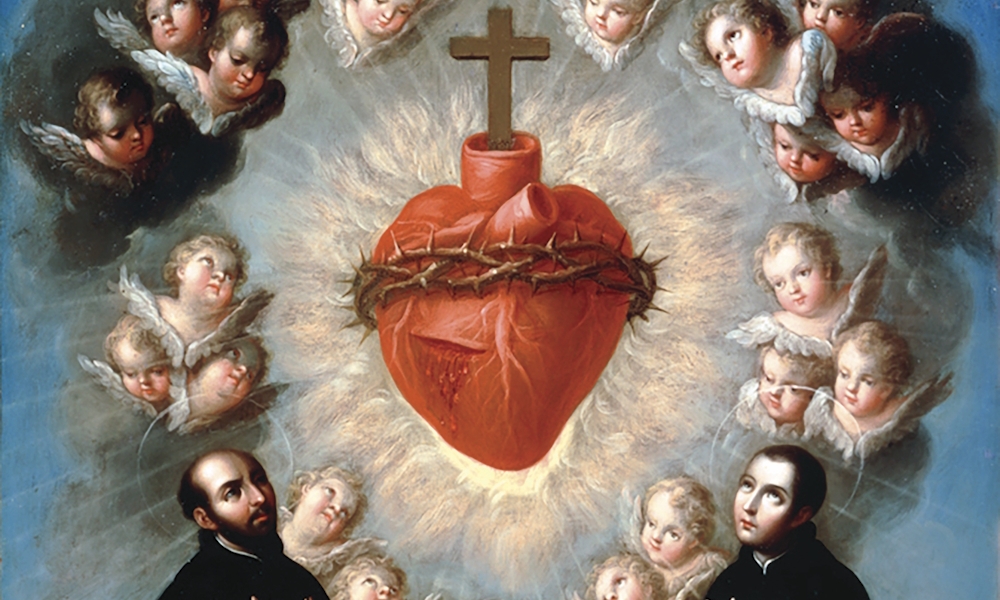
As well, the Sacred Heart of Jesus teaches us forgiveness. The only perfect act of forgiveness occurred when Jesus, dying on the cross, reconciled us to the Father: “Father, forgive them, they know not what they do.” (Lk 23:34) For us, who do not forgive as readily as our merciful God, forgiveness can be painful because of the wounds that have been caused by the one who hurt us. Added to this pain is the reality that we know we should forgive. We can even frustrate ourselves when we do not forgive as quickly or readily as we know God is calling us to do, but God does not desire to frustrate us, but to teach us how to forgive. That is why the image of the Sacred Heart displays the wounds of our Lord; it is a Heart that is pierced and crowned with thorns. When we approach the Lord in prayer, we unite our wounds to His, and He shares the love and forgiveness of His Heart with us. Jesus was wounded for our sake, and He sees our wounds, too. His Sacred Heart remains with us as a sign of hope that forgiveness is possible, even when we don’t think we can forgive. Thus, as we learn how God reconciled us to Himself, we also learn the way of reconciliation with our neighbor.
As we turn to the Most Sacred Heart of Jesus on this 250th anniversary of the signing of the Declaration of Independence, we give thanks for the gifts that God has bestowed upon us. Yet, we also ask that we might use the freedoms entrusted to us to love like the Sacred Heart of Jesus, to freely choose to order our lives loving God and loving neighbor, forgiving and being forgiven. If we do not use the freedoms enshrined in our national documents to freely choose to love God and freely choose to love our neighbors, then we are not truly free. The Sacred Heart of Jesus is depicted with fire, symbolizing the ardor of God’s love, freely given to us. Freely given this love by God, may we freely love others, encouraging one another on our heavenly pilgrimage until at last we all reach our eternal homeland forever.
Prayer to the Sacred Heart of Jesus
O most holy Heart of Jesus, fountain of every blessing, I adore You, I love You, and with a lively sorrow for my sins, I offer You this poor heart of mine. Make me humble, patient, pure, and wholly obedient to Your will.
Grant, good Jesus, that I may live in You and for You. Protect me in the midst of danger; comfort me in my afflictions; give me health of body, assistance in my temporal needs, Your blessings on all that I do, and the grace of a holy death.
Within Your Heart, I place my every care. In every need let me come to You with humble trust saying, “Heart of Jesus, help me.” Amen.
The Sacred Heart of Jesus
In the early 1670s, a French Visitation nun, St. Margaret Mary Alacoque, was blessed with apparitions of our Lord, during which Jesus not only revealed His Heart as a symbol of His love for man, but also promised special graces for those who practice devotion to the Sacred Heart with a Holy Hour on Thursdays and the reception the Eucharist and Mass on First Fridays. In 1765, the Vatican granted the feast of the Sacred Heart of Jesus to France, and almost 100 years later in 1856, Pope Pius IX extended the feast of the Sacred Heart to the Universal Church, which today is celebrated on the second Friday after Pentecost Sunday.
The promises of the Sacred Heart of Jesus
- “I will give them all the graces necessary for their state of life.
- I will give peace in their families.
- I will console them in all their troubles.
- I will be their refuge in life and especially in death.
- I will abundantly bless all their undertakings.
- Sinners shall find in My Heart the source and infinite ocean of mercy.
- Tepid souls shall become fervent.
- Fervent souls shall rise speedily to great perfection.
- I will bless those places wherein the image of My Sacred Heart shall be exposed and venerated.
- I will give to priests the power to touch the most hardened hearts.
- Persons who propagate this devotion shall have their names eternally written in my Heart.
- In the excess of the mercy of My Heart, I promise you that My all-powerful love will grant to all those who will receive Communion on the First Fridays, for nine consecutive months, the grace of final repentance: they will not die in My displeasure, nor without receiving the sacraments; and My Heart will be their secure refuge in that last hour.”
The symbols of the Sacred Heart
Flames
Symbolizes the purifying power of Christ’s love, which transforms the hearts of man.
Wound
Represents the wound inflicted at Christ’s crucifixion and His blood shed for our redemption.
Cross
A reminder of Christ’s crucifixion, the sacrifice made for the sins of the world.
Crown of Thorns
Represents Christ’s suffering, which He endured because of His boundless love for man.
Father Daniel Sessions is a priest of the Diocese of Birmingham in Alabama. After attending St. Rose Academy and John Carroll Catholic High School, he entered priestly formation and was ordained a priest in 2023. Father Sessions served as the Parochial Vicar of Holy Spirit Parish in Huntsville, while also assisting at St. John Paul II Catholic High School. In addition, he serves as an Auditor on the Diocesan Tribunal. Father Sessions received a Licentiate in Philosophy from the Catholic University of America in 2019, and he is currently studying for a Licentiate in Canon Law at the Pontifical Gregorian University in Rome.