‘For the poor mission territories of the world’
This fall will prove to be very exciting for the Pontifical Mission Societies, especially for the local Church throughout the United States.
This fall will prove to be very exciting for the Pontifical Mission Societies, especially for the local Church throughout the United States.
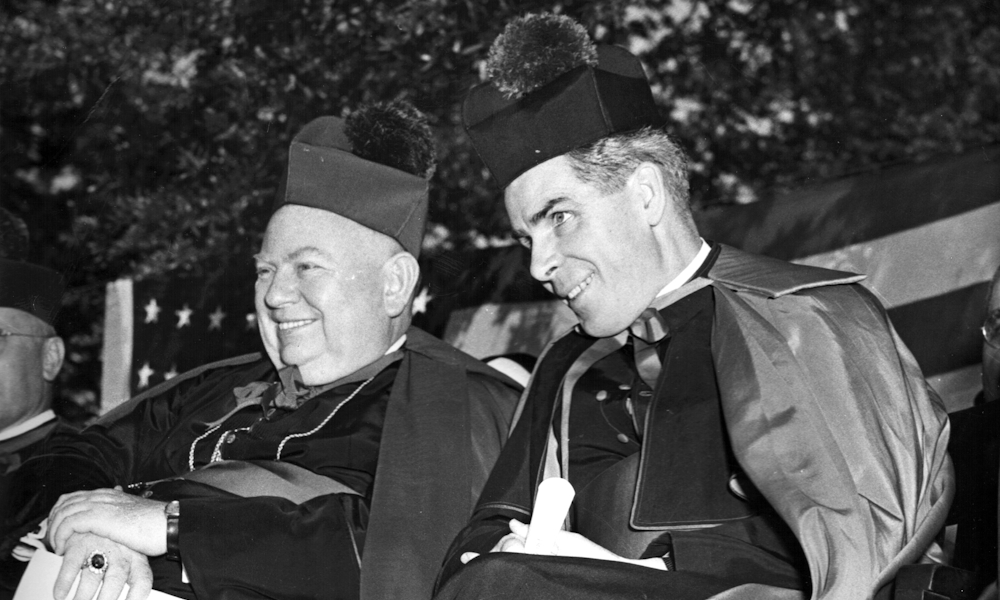
The first reason for celebration will be the beatification of Archbishop Fulton J. Sheen on Sept. 24 in St. Louis, Missouri, by Cardinal Luis Antonio Tagle. The soon-to-be Blessed was not only a renowned radio and television evangelist and author but also a longtime national director of the Pontifical Mission Societies in the United States.
On Oct. 18, less than a month after the archbishop’s beatification, the Universal Church will mark the 100th anniversary of the observance of World Mission Sunday, which was instituted by Pope Pius XI on April 14, 1926. The day of global prayer and sacrificial giving in support of missions, which takes place in every parish, in every diocese, in every country, is coordinated by the Society for the Propagation of the Faith, one of the Pontifical Mission Societies. This year’s theme, “One in Christ, united in mission,” was announced by Pope Leo XIV on June 1.
The connection between the two events is noteworthy and, according to the pope, “providential,” for just as Archbishop Sheen “touched millions with the hope of the Gospel,” fulfilling the call of every Baptized person to share the Good News, World Mission Sunday offers the entire Church the opportunity to take part in that very same mission through prayer, generosity, and witness.
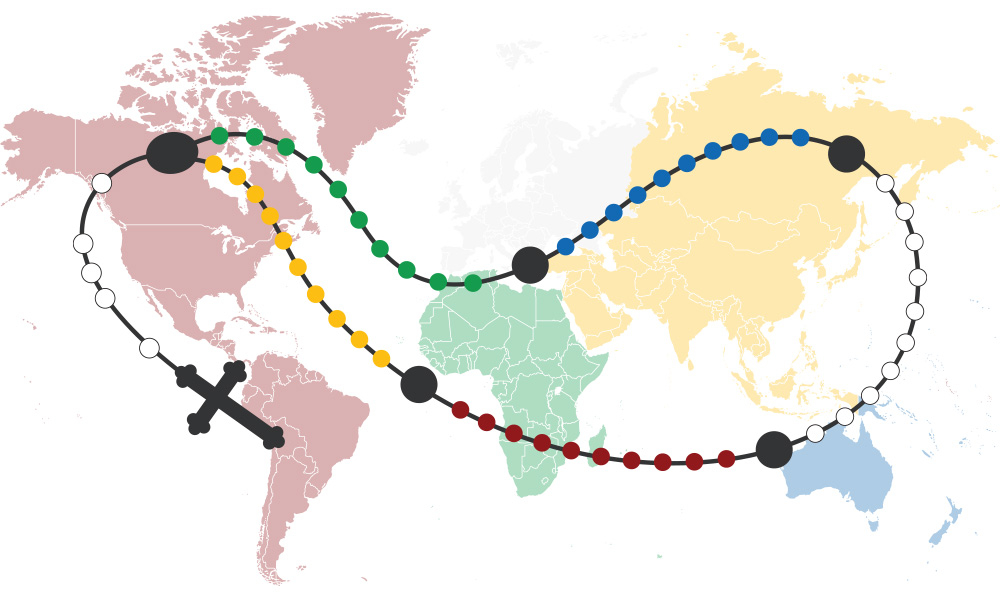
During his lifetime, Archbishop Sheen worked to help the faithful fulfill that mission. Shortly after his appointment as the national director of the Pontifical Mission Societies, he designed the World Mission Rosary in 1951, which is set to be prayed by the tens of thousands gathered for his beatification.
In explaining the Rosary, the archbishop pointed out that “we must pray, and not for ourselves, but for the world.” To that end, he noted that the World Mission Rosary would “aid the Holy Father and his Society for the Propagation of the Faith by supplying him with practical support, as well as prayers, for the poor mission territories of the world.”
The colorful beads of the rosary represent different areas of the world. Green symbolizes the forests and grasslands of Africa, and the blue beads represent the ocean surrounding the islands of the Pacific. Europe, as home of the Holy Father, is denoted by white beads. Red of the next decade signifies the “fire of faith that brought the first missionaries to the Americas.” Finally, the yellow beads symbolize Asia, “the morning light of the East.”
How to pray the World Mission Rosary
- Holding the Crucifix, make the Sign of the Cross, and pray the Apostles' Creed.
- On the first large bead, pray one Our Father.
- Pray one Hail Mary on each of the next three small beads.
- Pray the Glory Be.
- On the next large bead, meditate on the first Mystery then pray one Our Father.
- Pray a Hail Mary on each of the next ten beads, focusing on the corresponding area of the world and its people. Follow the last Hail Mary of the decade with a Glory Be and the Fatima Prayer.
- Continue in the same way for the next four decades.
- After the fifth decade is complete, pray the Hail Holy Queen.
Archbishop Sheen and Alabama
Even before Archbishop Fulton Sheen began his 16-year tenure as the national director of the Pontifical Mission Societies in the United States, he made his mark in Alabama. He and Archbishop Thomas J. Toolen, then bishop of the Diocese of Mobile, were not just mere acquaintances; rather, they were fast friends. It can be assumed that the friendship put the state on Archbishop Sheen’s radar. To the right are the archbishop’s documented visits, talks, fundraisers, and donations associated with the area now known as the Diocese of Birmingham in Alabama.
- 1941 — He provided funds to Bishop Toolen for a new parish in Trussville, which he named Holy Infant of Prague.
- 1941 — The archbishop helped finance the building of Immaculate Heart of Mary Church (now closed) in Hillview, near Forestdale.
- 1943 — From July 12-18, he gave various talks and lectures in the Birmingham area. The first three nights he lectured to the public in Fieldstown. The next three nights, he gave open lectures in Margaret, then known as Margaret Mines, at Our Lady, Queen of Heaven Chapel (now closed), which he helped build for the local Catholic coal miners. Throughout the week, he spent his days giving talks to local businessmen, meeting with priests, visiting the Birmingham Army Air Base, and addressing a gathering of Catholic Women. On his last day of public appearances in the area, he celebrated Mass at St. Paul’s Church in Birmingham and Holy Infant of Prague before speaking at the culminating event of his trip: a “Mammoth Outdoor Rally” at Blessed Sacrament Catholic Church in the West End neighborhood of Birmingham.
- 1947 — He dedicated St. Margaret, Queen of Scotland, Catholic Church (now closed) in Birmingham, which was built with $7,000 he donated to the parish. At his request, the church was named in honor of St. Margaret of Scotland.
- 1949 — After Our Lady of Sorrows Parish burned, Immaculate Conception, a parish for the local black Catholic community, moved to the available property. Bishop Sheen heard the news and financed the building of a church. The archbishop, however, made one request: He wanted the parish’s name to be changed to Our Lady of Fatima.
- 1951 — He provided financial assistance to Archbishop Toolen for the building of St. Thomas the Apostle Catholic Church in Montevallo.
- 1953 — In November, he addressed the Mobile Diocesan Council of the National Council of Catholic Women at the closing gathering at the Tutwiler Hotel in Birmingham. At the time, The Birmingham News reported that the event drew the “largest single audience ever gathered at the Tutwiler Hotel.”
- 1952 — The main altar for St. William Catholic Church in Guntersville was donated by Archbishop Sheen for the parish’s first permanent church building.
- 1960 — Sheen visited Birmingham for the third annual Melkite Laymen’s Convention of North America hosted by St. George Melkite Church. He closed the convention at the Tutwiler Hotel with a speech. He also concelebrated the Byzantine Rite Mass in English. During the convention, Sheen presented Fred Melof of West End with a “Cross of Jerusalem” for “his outstanding service as a layman to his church.”
Want to help?
On Oct.17-18, the Diocese of Birmingham will hold a second collection at each parish to support the Society of the Propagation of the Faith. Donations can also be made on bhmdiocese.org. For more information, please e-mail propfaith@bhmdiocese.org.