‘A joyful contradiction to the logic of the world’
Diocese celebrates World Day for Consecrated Life
Diocese celebrates World Day for Consecrated Life
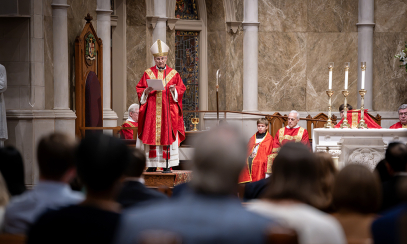
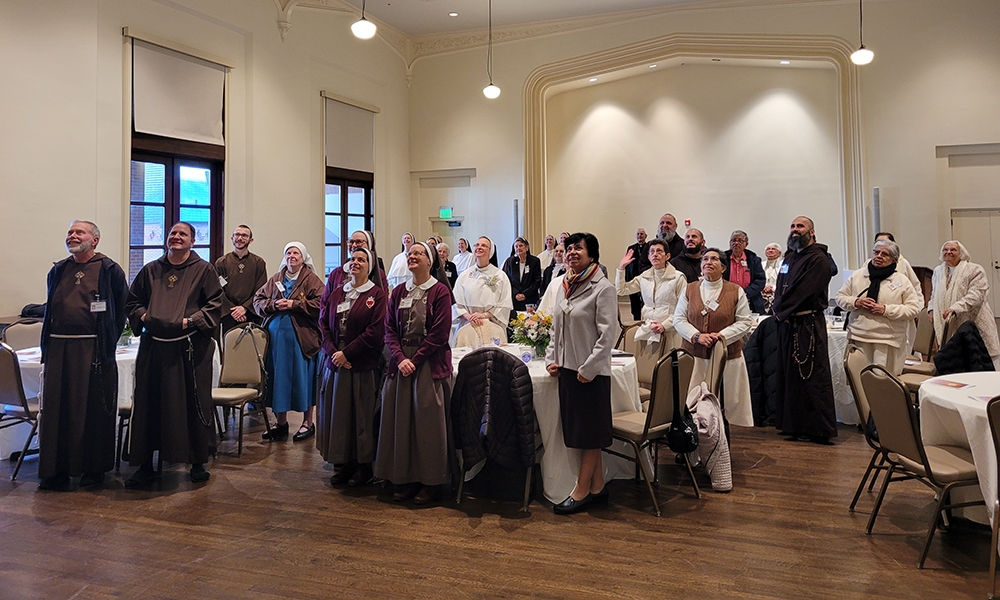
On Feb. 1, Bishop Raica celebrated Mass at the Cathedral of St. Paul in Birmingham, marking the World Day for Consecrated Life. According to the United States Conference of Catholic Bishops: “In 1997, Pope St. John Paul II instituted a day of prayer for women and men in consecrated life. This celebration is attached to the Feast of the Presentation of the Lord on Feb. 2. This feast is also known as Candlemas Day; the day on which candles are blessed symbolizing Christ who is the light of the world. So too, those in consecrated life are called to reflect the light of Jesus Christ to all peoples.” Locally, religious celebrating a jubilee anniversary are recognized at a luncheon following Mass. This year Sister Magdalena Craig, O.S.B. (60th jubilee); Sister Edith Bogue, O.S.B. (25th jubilee), Sister Miriam Kopenhafer, O.P. (25th jubilee), and Sister Anna Christi Solis, O.P. (25th jubilee) were honored. The complete text of the bishop’s homily follows herein.
On Feb. 1, Bishop Raica celebrated Mass at the Cathedral of St. Paul in Birmingham, marking the World Day for Consecrated Life. According to the United States Conference of Catholic Bishops: “In 1997, Pope St. John Paul II instituted a day of prayer for women and men in consecrated life. This celebration is attached to the Feast of the Presentation of the Lord on Feb. 2. This feast is also known as Candlemas Day; the day on which candles are blessed symbolizing Christ who is the light of the world. So too, those in consecrated life are called to reflect the light of Jesus Christ to all peoples.” Locally, religious celebrating a jubilee anniversary are recognized at a luncheon following Mass. This year Sister Magdalena Craig, O.S.B. (60th jubilee); Sister Edith Bogue, O.S.B. (25th jubilee), Sister Miriam Kopenhafer, O.P. (25th jubilee), and Sister Anna Christi Solis, O.P. (25th jubilee) were honored. The complete text of the bishop’s homily follows herein.
Brothers and sisters in Christ, once again, a warm welcome on this cold blustery weekend to all who braved the chill to come to Mass today at our Cathedral of St Paul. Today the Church rejoices. Our hearts are light, our gratitude is deep, and our hope is renewed as we commemorate the men and women in consecrated life who serve so faithfully throughout our diocese. Although the universal Church typically marks this celebration on Feb. 2, the Feast of the Presentation of the Lord, when Simeon and Anna go out to meet Christ, today we, too, go out to meet Christ by honoring those who have consecrated their entire lives to Him.
The Old Testament prophet Zephaniah sets the tone for our celebration: “Seek the Lord, all you humble of the earth.” (Zeph 2:3) Consecrated life is a living response to that invitation. It is a choice—renewed daily—to seek the Lord above all else, to trust not in strength, status, or worldly security, but in God alone. Zephaniah speaks of a humble and lowly people who find refuge in the name of the Lord. That description fits beautifully the witness of consecrated men and women: lives hidden with Christ, yet profoundly fruitful for the Church and the world.
St. Paul, writing to the Corinthians, presses this point even further: “Consider your own calling.” (1 Cor 1:26) God does not choose as the world chooses. He delights in what appears small, simple, and weak, so that His power may shine forth. Consecrated life stands as a joyful contradiction to the logic of the world. Poverty, chastity, and obedience proclaim that Christ is enough—and more than enough.
Each religious family represented in our diocese traces its roots to a patron or founder or foundress who dared to dream with God: St. Benedict, whose vision of prayer and work shaped Christian civilization; St. Dominic, consumed with love for truth and the preaching of the Gospel; St. Francis and St. Clare, who embraced radical poverty to mirror the humility of Christ; Blessed Joseph Allamano, the Consolata Sisters, aflame with missionary zeal; Brother Juan Fromental Cayroche, the Guadalupana Sisters, spreading the Gospel and assisting those in need; Father Gilson Sobreiro, the Poor of Jesus, who served the marginalized and impoverished people of the street; St. Paul of the Cross, who proclaimed God’s love for the world through the passion of Christ; Venerable Mother Isabella de Rosis, who sought reparation for sin through prayer, service, and love; Father John Slattery and Father Charles Uncles, the Josephite priests, who are dedicated to the African-American ministry; Blessed Francis Mary Jordan, proclaiming the goodness and kindness of Jesus the Savior; Fathers Thomas Palackal, Thomas Porukara, and Kuriakose Elias Chavara, (Carmelites of Mary Immaculate, contemplation and handing on to others the fruit of contemplation of Christ and our Blessed Mother; Mother Adela Galindo, to witness the heart of Jesus through the heart of Mary.
These represent a sampling of the orders and communities on mission in our diocese. They are like a mosaic, a tapestry, an orchestra, a quilt – each unique, but essential to the mission of Christ.
Each founder received a charism, a gift of the Spirit, not for themselves alone, but for the whole Church. As Vita Consecrata reminds us, “Every charism is given for the good of the whole Body.” (VC, 48) These charisms do not compete with the institutional Church: they complement and enliven her. They are like fresh winds that keep the Church young, missionary, and close to the poor. They breathe new life into the Church’s mission.
Some, like the Poor Clares, live lives largely hidden from the world; lives of silence, solitude, and intercessory prayer. Others serve in education, forming minds and hearts. Still others minister through healthcare, social services, parish life, and direct service to those on the margins-different ministries, different rhythms of life, but one love, one Lord, one total gift of self.
The Gospel today, the familiar Beatitudes, takes us straight to the heart. Jesus speaks not of rules and regulations, but of dispositions of the soul: poverty of spirit, meekness, mercy, purity of heart, a hunger for righteousness. These are not abstract ideals. They are embodied realities, which add notes of harmony to the symphony of ecclesiastical life. We see them lived every day in consecrated life. Pope Francis has said that consecrated persons are called to be “a living exegesis of the Word of God”—the Gospel made visible in flesh and blood.
Above all, consecrated men and women accompany us. You walk with us in our joys and sorrows, our worries and moments of despair. You pray with us and for us. You remind us that Heaven is our true homeland and that our hope must always be anchored in Christ. As Vita Consecrata beautifully states, “Consecrated life proclaims that God is the absolute future of humanity.” (VC, 7)
Dear brothers and sisters in consecrated life, thank you. Thank you for your “yes,” your faith, your courage, your fidelity, and your joy. We would indeed be impoverished without you. With you, the Church in Birmingham is abundantly blessed and enriched.
May your witness continue to inspire us all to seek the Lord, to consider our own calling, and to live the Beatitudes with renewed conviction. And may Mary, the first and perfect disciple, accompany you always as you continue to go out to meet Christ and to help all of us do the same. Amen.