The Jubilee Year of St. Francis
May his example renew our diocesan Church
May his example renew our diocesan Church
My sisters and brothers, in every age of the Church, certain figures emerge whose witness seems to transcend time, culture, and even creed. St. Francis of Assisi is one of those rare souls. Eight centuries after his life, he continues to capture the imagination not only of Catholics, but of Christians of every tradition, and even of those who would claim no formal faith at all. There is something about Francis — his simplicity, his joy, his radical love — that speaks to the deepest longing of the human heart.
My sisters and brothers, in every age of the Church, certain figures emerge whose witness seems to transcend time, culture, and even creed. St. Francis of Assisi is one of those rare souls. Eight centuries after his life, he continues to capture the imagination not only of Catholics, but of Christians of every tradition, and even of those who would claim no formal faith at all. There is something about Francis — his simplicity, his joy, his radical love — that speaks to the deepest longing of the human heart.
As we mark this special year dedicated to St. Francis within our diocesan family, we do so with gratitude for the many ways his spirit is already alive among us. In our diocese, we are blessed with religious communities shaped by the Franciscan charism, as well as parishes in Bessemer, Livingston, Talladega, and Tuscaloosa that bear his name. These are not merely historical connections; they are living reminders that the Gospel life Francis embraced is still possible, and still compelling, today.
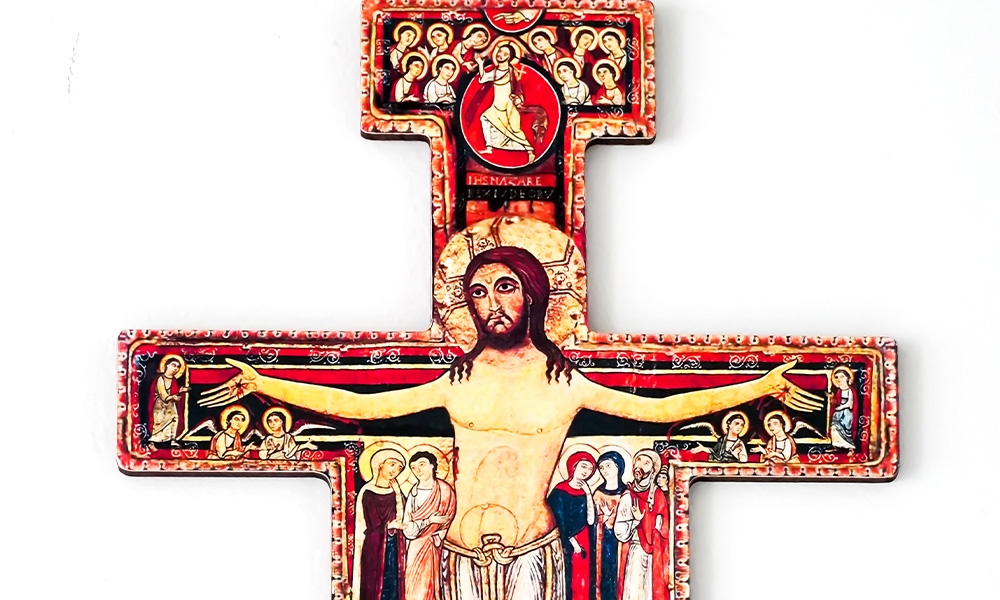
St. Francis’ enduring appeal begins with his singular focus on Christ. His life was not driven by ideology or ambition but by a profound encounter with the crucified Lord. From the moment he heard Christ speak to him from the cross of San Damiano, “Rebuild My Church,” Francis understood that renewal begins not in structures but in the human heart. He once wrote, “Let us begin again, for up to now we have done nothing.” That humility, that constant readiness to start anew, is perhaps one of his greatest lessons for us. With that, he embarked on internal and external reforms that touched the very heart and life of the Church herself.
Yet St. Francis did more than contemplate the mysteries of Christ, he helped ordinary people see them. In the Italian village of Greccio, he famously arranged the first Christmas crèche, inviting the faithful to behold with their own eyes the poverty and wonder of the Incarnation. The Word made flesh was no longer a distant idea, but a living reality placed before them in straw and silence. In a similar spirit, the devotional path that would later develop into the Stations of the Cross finds its roots in Franciscan love for the Passion, a desire to walk with Christ, step by step, along the road to Calvary. In these ways, St. Francis gave the Church not only words but images and practices, indeed forms of prayer that engage the senses, stir the imagination, and draw the heart more deeply into the mysteries of our faith.
We are the heirs of this living catechesis. Every Nativity scene that invites us into Bethlehem, every set of Stations that leads us along the way of the Cross, carries something of St. Francis’ vision. Through art, music, and devotion, the Scriptures come alive, not as distant history but as a present encounter. In a world often dulled by abstraction, Francis reminds us that God meets us concretely, tenderly, even visibly, in the circumstances of our lives.
Francis’ love for Christ also overflowed into a love for all creation. He saw the world not as something to be used, but as a gift to be reverenced and cherished. In his Canticle of the Creatures, he praises “Brother Sun” and “Sister Moon,” recognizing in all things a reflection of the Creator’s goodness. In our own time, Pope Francis has echoed this vision in Laudato Si’, reminding us that “everything is connected” and calling us to a renewed respect for our common home.
St. Francis is also remembered as a man of peace. In a world marked by division and conflict, his spirit of reconciliation remains strikingly relevant. The beloved prayer often attributed to him, “Lord, make me an instrument of your peace,” continues to be prayed by millions. Whether or not he composed those exact words, they faithfully express the spirit of his life. He crossed battle lines during the Crusades to meet the sultan, not as an adversary but as a brother. His witness challenges us to ask: How do we bring peace into our world, our homes, our parishes, our communities? How can I have peace in my own life?
Perhaps what draws so many to St. Francis is the authenticity of his life. He did not merely speak about the Gospel; he lived it with disarming clarity. He embraced poverty not as deprivation but as freedom: the freedom to love without condition, to depend entirely on God. As Pope Benedict XVI once observed, Francis “understood that by renouncing everything, he gained everything.” That paradox lies at the heart of the Christian life.
In a culture often marked by excess, noise, and distraction, St. Francis offers a different path: simplicity, joy, and trust. He reminds us that holiness is not reserved for a few. It is a universal call available to all. Each of us, in our own vocation and circumstances, can live the Gospel more deeply, love more generously, and walk more humbly with our God.
As we celebrate this Year of St. Francis, may his example renew our diocesan Church. May he teach us to fix our eyes on Christ, to contemplate more deeply both the mystery of His birth and the mystery of His saving Cross, to cherish God’s creation, and to become instruments of peace in a world that longs for healing. And may we, like St. Francis, have the courage to begin again. How can I reflect the life of St. Francis in my life today? Do I cherish the Christmas and Lenten devotions which he inspired? Do I live with simplicity? Do I seek after peace? Do I respect the world around me? Yes, St. Francis is at the heart of it. He remains an inspiration for us today to “rebuild” the Church by the way we follow Christ!
A blessed summer to all of you!
The Most Reverend Steven J. Raica is the fifth bishop of the Diocese of Birmingham in Alabama.