Accompanying souls and cultivating the liturgical arts
Bishop celebrates Mass for the 43rd Conference of Roman Catholic Cathedral Musicians
Bishop celebrates Mass for the 43rd Conference of Roman Catholic Cathedral Musicians
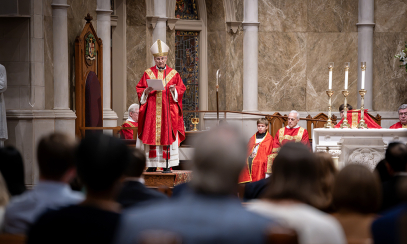
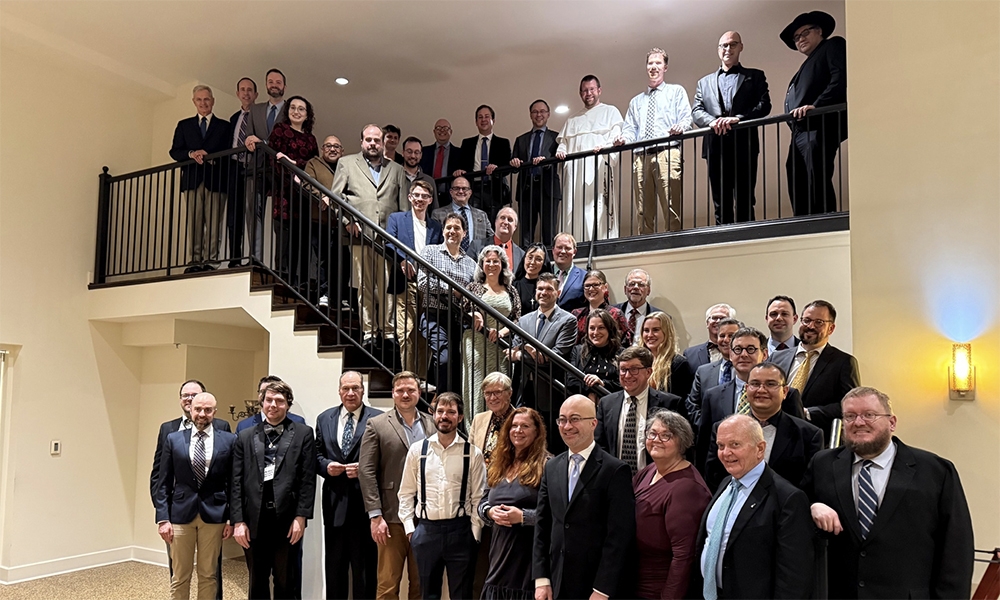
On Jan. 5, Bishop Raica celebrated an opening Mass for attendees of the 43rd Conference of Roman Catholic Cathedral Musicians. The occasion marked the first time the Diocese of Birmingham acted as host of the conference. More than 60 musicians from cathedrals and shrines around the country traveled to Birmingham to attend the Jan.5-8 gathering.
On Jan. 5, Bishop Raica celebrated an opening Mass for attendees of the 43rd Conference of Roman Catholic Cathedral Musicians. The occasion marked the first time the Diocese of Birmingham acted as host of the conference. More than 60 musicians from cathedrals and shrines around the country traveled to Birmingham to attend the Jan.5-8 gathering.
Brothers and sisters in Christ, and in a particular way, my dear sisters and brothers who serve the Church as Cathedral musicians, it is a grace to welcome you to the Cathedral of St. Paul here in downtown Birmingham. I especially thank Bruce Ludwick and Father Jerabek, our Cathedral rector, for this opportunity to be here today with you. You have come from across the United States, to the Deep South, (hoping to experience some of our warm southern hospitality!) carrying with you the soundscape of prayer from many diverse dioceses, many cultures, many communities. It is fitting that we gather in a cathedral where the bishop’s chair reminds us that the liturgy we celebrate is never private, never isolated, but always an act of the whole Church, proclaiming Christ to the world, as Lord and Savior, as Word made Flesh Who dwells with us as we proclaim Him by our lives.
Providentially, we celebrate this Mass on the feast of St. John Neumann, Bishop of Philadelphia. His life offers a striking lens through which to view your vocation.
In a well-known letter to Cardinal Barnabò of the Congregation for the Propagation of the Faith, Bishop Neumann speaks with remarkable honesty and sobriety. He describes himself as unworthy and inept for episcopal responsibilities. He does not romanticize his pastoral leadership. He even expresses a willingness to resign if that would better serve the pastoral good of the Church, yet having catalogued his limitations, he concludes with a profound act of faith. He commits himself to “fulfilling the wish of the Holy Father, whatever it may be.” This is obsequium: not blind submission, but a deeply ecclesial posture of trust, humility, and perseverance to ultimately fulfill the will of Christ Himself in our vocational journey.
That same posture runs through today’s readings.
In the First Letter to the Corinthians, St. Paul tells us: “If I preach the Gospel, this is no reason for me to boast.” He speaks of compulsion, not coercion-an interior necessity born of love. “I have made myself all things to all, to save at least some.” Paul’s ministry is not self-referential. It is entirely ordered to the Gospel, entirely shaped by the needs of those he serves, regardless of whichever community he finds himself in.
The Gospel presents Christ Himself as the model: “I am the Good Shepherd.” The Good Shepherd does not dominate; He knows His sheep, calls them by name, lays down His life for them, and draws them into one flock. Leadership, especially pastoral leadership, in the mind of Christ, is always relational, sacrificial, and oriented toward communion.
We then sing with the psalmist: “Proclaim His marvelous deeds to all the nations.” The Church proclaims not only with words, but with melody, harmony, and beauty. The psalm itself assumes that music has a unique capacity to carry the wonder of God beyond the limits of speech.
This is where your vocation comes into sharp focus.
Sacred music is not an ornament added to the liturgy. It belongs to the very act of worship. It has the power to move the human heart toward a heightened spiritual awareness of the mystery of God—His grace, His mercy, His love. Like all true art, music touches something deep within the human person. It can give praise. It can teach. It can console. It can hold joy and sorrow at the same time. It can carry faith when words alone are insufficient.
You understand this not only theoretically, but practically. You know that your ministry is not simply the execution of difficult repertoire or the mastery of technique—important as those are. Your deeper task is to accompany souls: to accompany a congregation into Advent longing, Christmas joy, Lenten repentance, Easter exultation, Ordinary Time fidelity, and the solemn moments of grief and hope that mark human life.
This is why your work is more than performance. It is the cultivation of the liturgical arts—arts shaped by the Church’s prayer, disciplined by her tradition, and open to the needs of real communities. The Church asks much of you: to honor her treasured musical heritage, including Latin and Greek; to be attentive to new languages and cultural expressions that reflect the character of your dioceses; to seek music that is time-tested, theologically sound, and musically worthy of the sacred mysteries it serves.
At its best, sacred music gives voice to what is happening at the deepest level of the liturgy: the meeting point of God’s search for us and our search for the infinite reality. In that meeting, something extraordinary happens. As the Fathers of the Church loved to say, the liturgy is a place where Heaven and earth touch. It is a place where—mysteriously and beautifully—our Father sings to us, and we learn how to respond.
Here again, St. John Neumann instructs us. He carried on: not because he felt adequate, but because he trusted that fidelity itself would bear fruit. In your own way, you do the same. Week after week, feast after feast, you offer your gifts in service to something larger than yourselves. You do what the Church is asking, even when it is demanding, even when it is imperfectly received, even when it goes unnoticed.
My hope is that your time together here will strengthen that resolve. May it be a time to support one another, to learn from one another, and to renew your shared commitment to this noble ministry. The Church needs your skill, your discernment, your faith, and your perseverance.
Through your service, may many come to glimpse—perhaps for the first time—the saving mystery of God made audible, tangible, and beautiful. May St. John Neumann intercede for you, that like him, you may continue faithfully, humbly, and joyfully in the work entrusted to you, for the glory of God and the sanctification of His people.