‘Where am I standing?’
Bishop marks Good Friday
Bishop marks Good Friday
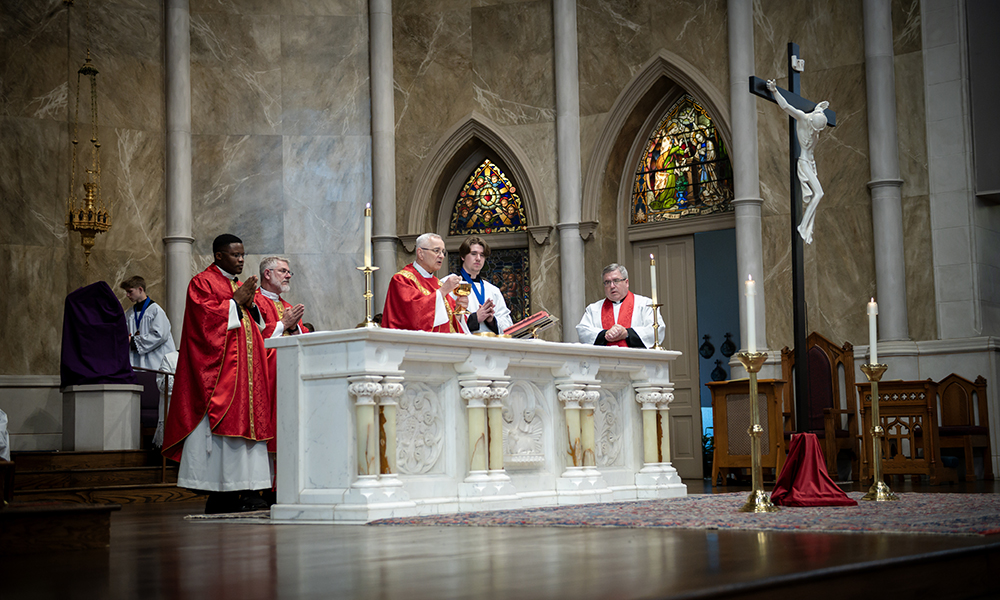
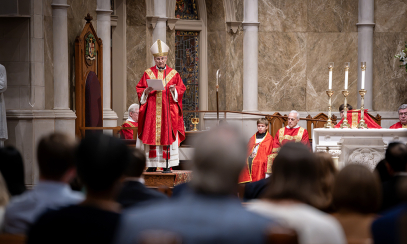
On April 3, Bishop Raica celebrated the Solemn Liturgy of Good Friday at the Cathedral of St. Paul in Birmingham. The complete text of the bishop’s homily follows herein.
On April 3, Bishop Raica celebrated the Solemn Liturgy of Good Friday at the Cathedral of St. Paul in Birmingham. The complete text of the bishop’s homily follows herein.
My sisters and brothers, there is a kind of silence that falls over us on Good Friday. It is not the peaceful silence of a quiet evening. It is the silence that occurs when words fail, when something is too heavy, too deep, too painful to explain. Oftentimes, it is a time when we want to run away like the disciples. It is a time of anguish and unconsolable grief.
We have all known that silence. It comes in a hospital room; in the middle of the night when sleep will not come; in the moment when a phone call or knock at the door changes everything; in the quiet realization that something we loved, that gave us meaning and life, that we cherished, is slipping away. We realize that we have them only for a time but cannot cling to them for eternity.
And yet on this day, we stand in that silence at the foot of the Cross contemplating the past, reviewing our memories, recounting with nostalgia the good times and experiences that shaped our thoughts, opinions, and outlook.
There, before us, is Jesus Christ. But the Gospel does something remarkable. It does not only show us Jesus. It draws our attention to who is standing with Him.
The Passion of St. John’s Gospel informs us of a particular interesting detail: “Standing by the Cross of Jesus were His mother, and His mother’s sister, Mary the wife of Clopas, and Mary Magdalene. When Jesus saw His mother and the disciple whom He loved standing nearby, he said to His mother, ‘Woman, behold, your son!’ Then He said to the disciple, ‘Behold, your mother!’” (John 19:25–27) And suddenly, the Cross is no longer just a place of execution, it becomes a place of relationship.
First, there is Mary. She does not speak. She does not intervene. She does not flee. She stands, overwhelmed by unquenchable grief and unconsolable sorrow. On a day that would have shattered any mother’s heart, Mary remains steadfast in faith because she knows Who Jesus is! Hers is a faith that sees beyond pain to promise, even when the promise is shrouded in darkness. As St. Ambrose once said, “She stood in faith, she stood in sorrow, she stood in love.” (De Virginibus)
Mary teaches us something that we have difficulty accepting - love does not always remove suffering. Sometimes love means staying, remaining with the one you love. Staying when there are no answers. Staying when we cannot fix what is broken. Staying when the only thing we can offer is our presence.
Some here today know exactly what that means. You have stood at a cross of your own: beside a loved one, inside a grief, carrying a burden that no one else fully sees or understands. Mary stands with you because she knew that anguish personally.
Then there is a second figure: John the Apostle, whom we know as the “beloved disciple.” He is the only one of the Twelve who has come this close. The others seem to have fled or are standing in the back watching nervously. He does not fully understand what is happening. He does not know how this story will end. And yet, he stays. And in that moment, Jesus speaks to him: “Behold your mother.” And then to Mary: “Behold your son.”
Even now, especially now, Jesus is giving. As St. Augustine of Hippo reflected, “He was hanging on the Cross, and yet He was giving gifts.” (St Augustine, Sermon 227) Think of that. As His life is being taken from Him, He is still creating relationships. He gives Mary a son. He gives John a mother. He gives us to one another.
This is not a small detail: This is the birth of something new. At the foot of the Cross, the Church is born not as an idea, but as a family. And John receives her “into his own.” That is to say, “into his life.”
That is precisely what it means to be a disciple: to receive what Jesus gives, even when it is unexpected, even when it is costly.
And then there is the crowd - the mostly nameless bystanders. They are there, too. Some are indifferent. Some are curious. Some are hostile. Some are afraid.
And if we are honest, at different moments in our lives, we have been each of them. At times we stand close, like John. At times we stand faithful, like Mary. And at times, we keep our distance blending in like everyone else.
So, perhaps the question we have to grapple with today is not simply what happened on Good Friday. The question is this: Where am I standing? Where am I in relation to the Cross? Where am I in relationship to Christ?
Because here is the deeper truth that Good Friday reveals: Even when we do not understand what God is doing (even when we cannot see how the story will end), we are not alone.
That is the quiet and subtle miracle of this moment. Jesus does not remove the Cross. But He transforms what it means to stand beneath it. You are not alone in your suffering. You are not alone in your grief. You are not alone in your uncertainty. Because at the Cross, He gives you a mother. He gives you a family. He gives you Himself.
Lucky for us, we know how the story ends. We know that Easter is coming and will arrive. But the truth is this: when we are in the middle of our own Good Fridays, we do not feel that ending. We live, as it were, between the Cross and the Resurrection. And it is there, in that in-between place, that this Gospel speaks most powerfully.
In so many words, it tells us: Even when you cannot see the ending, you are still held in the love of Christ. As St. Teresa of Calcutta once said, “In the Cross, we know how much God loves us.” (Mother Teresa, A Simpler Path, 1994)
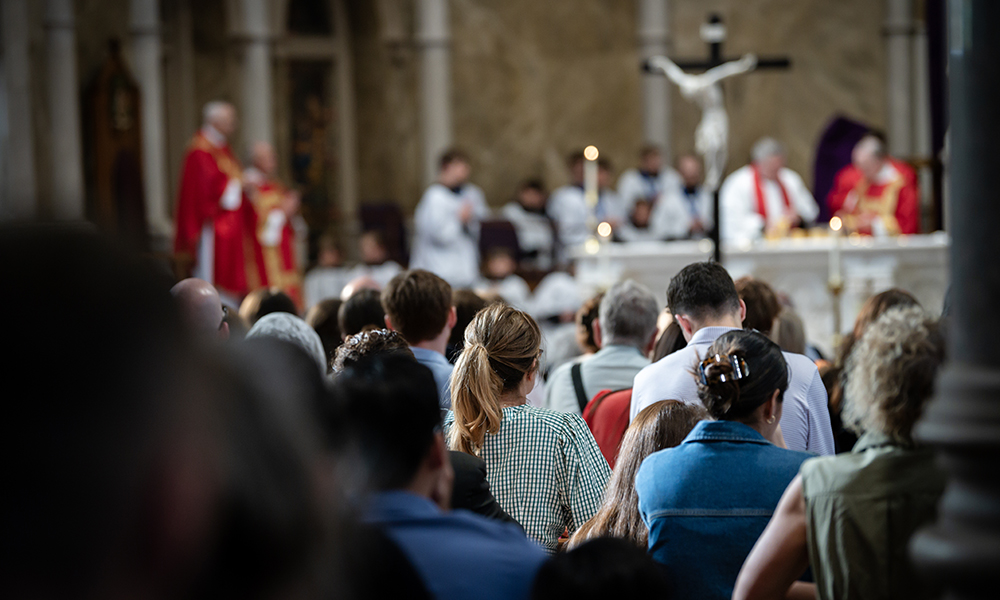
So today, in a few moments, as we venerate the Cross, we do not come forward as strangers. We come as sons and daughters. We come as those who have been entrusted to one another. We come as those who stand, perhaps trembling, perhaps uncertain, perhaps confused, perhaps tired, but we are not alone.
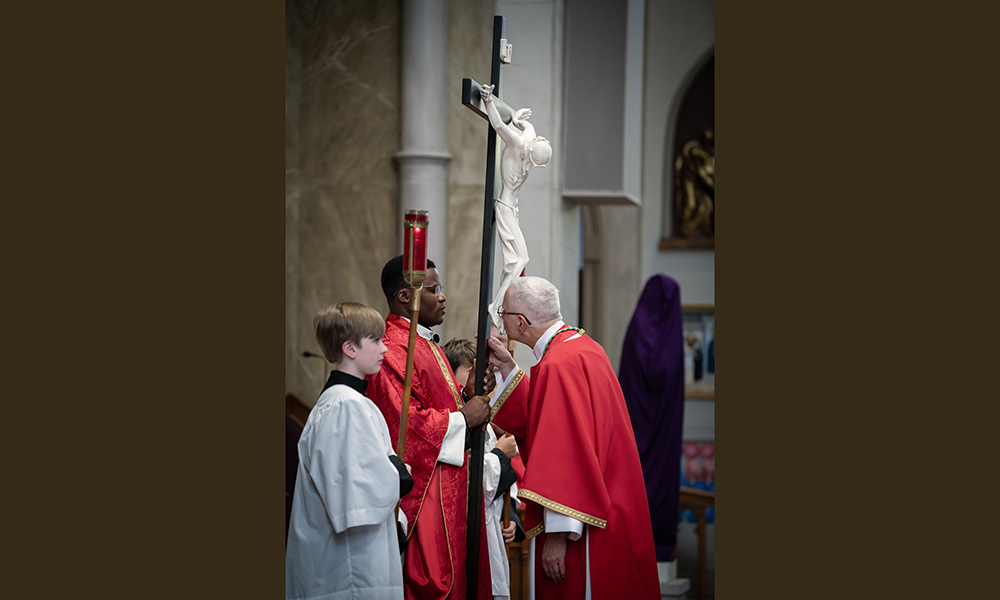
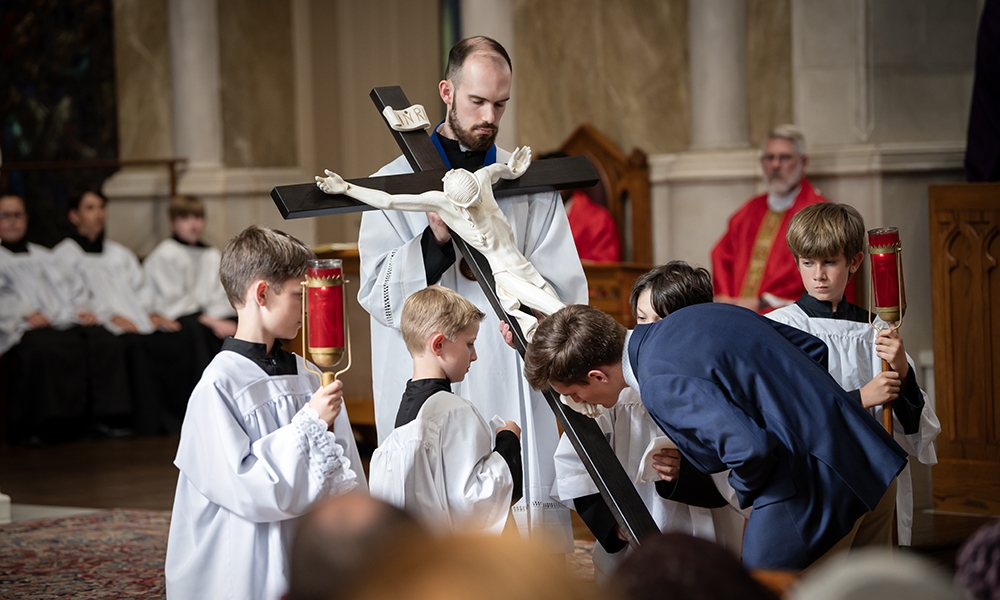
When we venerate the Cross in a few moments, and the priest lifts it slowly before our eyes “Behold the wood of the Cross, on which hung the salvation of the world.” We are not remembering something long past. We are entering into it. We are inviting this Cross to take root in the soil of our own hearts and be a source of grace for us.
And perhaps the grace to ask the Lord, in the midst of the cross of life that we face, that we learn where to stand. To stand with Mary in faith. To stand with John in trust. To stand near Jesus in love and often times in silence.
And when all is silent, when the world seems dark, when the outcome is not yet clear, remember this: At the foot of the Cross, when everything seemed lost, Jesus was still giving.
And He has already given you what you need most: You are not alone. From that place of pain and glory, love still speaks, mercy still flows, and hope still begins anew. Behold the Cross, the sign of life; Behold your Mother; Behold your Savior; Behold your victory is at hand. Amen.