‘Go forth and become for others what Christ has first become for us’
Bishop Raica commemorates the consecration of the nation to the Sacred Heart of Jesus
Bishop Raica commemorates the consecration of the nation to the Sacred Heart of Jesus
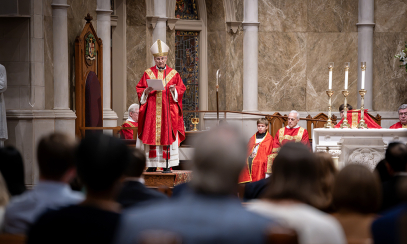
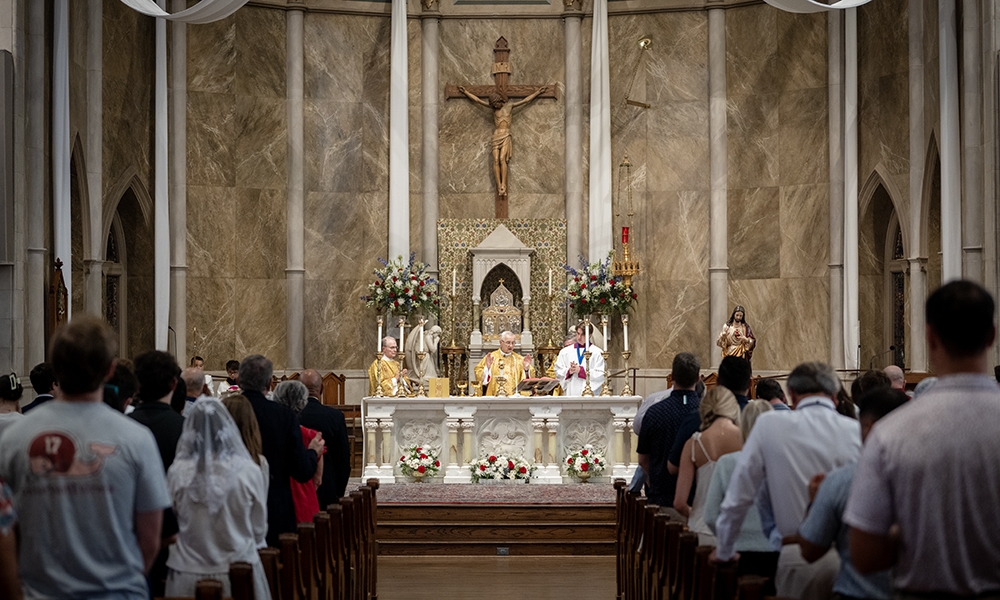
On June 14, Bishop Raica celebrated Mass at the Cathedral of St. Paul in Birmingham, marking the transferred Solemnity of the Sacred Heart of Jesus and locally commemorating the consecration of the United States to the Sacred Heart of Jesus, which took place June 11. The complete text of the bishop’s homily follows herein.
On June 14, Bishop Raica celebrated Mass at the Cathedral of St. Paul in Birmingham, marking the transferred Solemnity of the Sacred Heart of Jesus and locally commemorating the consecration of the United States to the Sacred Heart of Jesus, which took place June 11. The complete text of the bishop’s homily follows herein.
My dear brothers and sisters in Christ, this past Thursday, my brother bishops and I participated in a Mass at the Shrine of Mary, Queen of the Universe in Orlando, Florida, to consecrate our nation to the Sacred Heart of Jesus. Here throughout the Diocese of Birmingham, all parishes are to join in this holy Mass commemorating that event. To be sure, it is a beautiful feast day. Wherever I have turned in my life, the Sacred Heart of Jesus was present. It was the name of my parish when I was a child, the name of my elementary school, the name of the seminary I first attended. In Rome, I lived in the residence (Casa Santa Maria) where St. Margaret Mary Alocoque, the Visitation Sister who promoted the devotion to the Sacred Heart, was named a Servant of God. All through my life, this feast day has accompanied my journey as a Christian.
At the center of this feast is a simple but life-changing truth. We are loved - not because we earned it, not because we deserve it, and not because we are successful, powerful, influential, or perfect. We are loved because God has chosen us.
In the first reading from Deuteronomy, Moses reminds Israel that God did not choose them because they were the largest or strongest of peoples. Rather, "it was because the Lord loved you." The Sacred Heart reveals the same truth for us. Before we ever loved God, God loved us. Before we sought Him, He sought us out. Before we reached toward Him, His Heart was already reaching toward us. St. John expresses it beautifully in today's second reading: "In this is love: not that we have loved God, but that He loved us first."
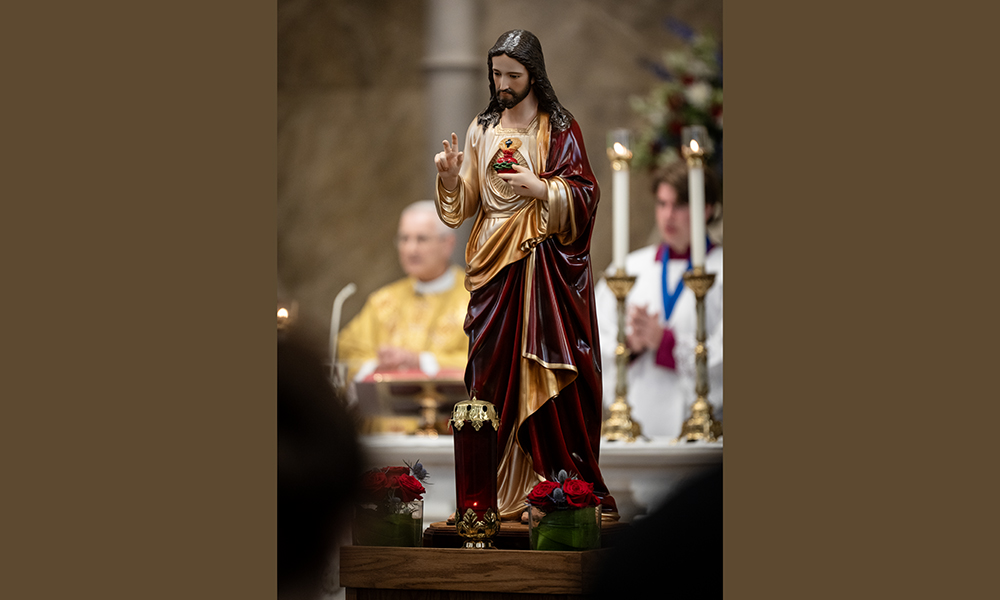
The Sacred Heart is the visible sign of that love. Whenever we look upon the image of the Sacred Heart, we see a heart that has been pierced, wounded, and opened. We see flames of divine charity. We see a heart crowned with thorns and yet burning with mercy. The Heart of Jesus tells us something essential about God: God is not distant. God is not indifferent. God is not detached from the struggles of humanity. The Heart of Jesus is God's answer to every fear that we are forgotten, abandoned, or unloved.
Pope Francis, in his final encyclical Dilexit Nos ("He Loved Us"), reminds us that "in the Heart of Christ, we find the whole Gospel" and that devotion to the Sacred Heart is "a synthesis of the Gospel." He warns against a culture that is becoming increasingly "heartless" and calls us back to the love revealed in Christ's Heart.
How much our world needs that message today. We live in a society marked by division, suspicion, and polarization. Too often people are categorized, labeled, dismissed, or reduced to political positions, ethnic backgrounds, economic status, immigration status, age, race, or ideology. The Sacred Heart reminds us that every human person possesses an inviolable dignity because each person is created in the image and likeness of God. When Christ looks upon a person, He does not first see a category. He sees a beloved son - a beloved daughter. He sees someone worth dying for. After all, He died for you. He died for me. The Sacred Heart challenges us to see others the same way.
We felt it opportune to consecrate our nation to the Sacred Heart of Jesus as our nation approaches its semi-quincentennial (250th anniversary of her founding). We are mindful that in a time of social fragmentation, this act points us back to the source of true unity: the love of Christ, which transcends every human division. This feast also speaks powerfully to our own wounds. Every one of us carries wounds. Some are visible. Many are hidden. These wounds are described in a variety of terms: disappointments, regrets, broken relationships, loneliness, grief, sin.
The temptation is to hide those wounds from God, yet the Sacred Heart invites us to do precisely the opposite. The wounded Heart of Jesus invites us to place our wounds into His. Christ is concerned not only with our present circumstances but with our eternal destiny. His pierced side on Calvary reveals a love that enters fully into human suffering in order to redeem it. Our wounds do not have the last word. His love does.
St. Margaret Mary Alacoque, the Visitation Sister from France, to whom the Lord revealed His Sacred Heart in a special way, heard Jesus say: "Behold this Heart which has so loved men that it has spared nothing, even to exhausting and consuming itself in order to testify its love."
That is the mystery we celebrate today: A Heart that holds nothing back. A Heart that spends itself completely. A Heart that loves unto the end. In last year's homily for the Solemnity of the Sacred Heart, Pope Leo XIV spoke of the need for a Church and a world that are "reconciled with one another, united, and transformed by the love that flows abundantly from the Heart of Christ." He called believers to become instruments of communion and reconciliation in a divided world.
This is where today's feast becomes intensely practical. The Sacred Heart is not merely an object of devotion. It is a way of life. If Christ has loved us this way, then we must love others this way. If Christ has shown mercy to us, we must show mercy to others. If Christ has entered our wounds, we must not ignore the wounds of our brothers and sisters. This is why the devotion to the Sacred Heart has always led believers toward the spiritual and corporal works of mercy: to feed the hungry, to shelter the homeless, to visit the sick, to comfort the sorrowful, to forgive injuries, to instruct the ignorant, to pray for the living and the dead.
Love is not a static word. Love is dynamic. Love moves. Love goes forth. Love gives. Love sacrifices. Love serves. The Heart of Christ is always outward-moving. The Heart that rests in the Father's love becomes the Heart that embraces the sinner, heals the sick, forgives the enemy, welcomes the stranger, and carries the cross.
That same Heart now beats within the Church. And so, Jesus speaks to us in today's Gospel: "Come to Me, all you who labor and are burdened, and I will give you rest." Notice that He does not say, "Come to Me after you have everything figured out." He simply says, "Come." Come with your burdens. Come with your failures. Come with your fears. Come with your wounds. Come to My Heart. It is wide open. It is waiting for you so that I can lavish you with a love that is sublime. And there, discover the truth that can transform every human life - You are loved; you are chosen; you are forgiven; you are called.
And then, having received that love, we go forth and become for others what Christ has first become for us.
May the Sacred Heart of Jesus teach us to see every person with His eyes wide open, to love every person with His tender Heart, and to lead every person toward the eternal destiny for which they were created – union with Christ forever.
Most Sacred Heart of Jesus, have mercy on us. Amen.