
Dominican Congregation of Christian Doctrine
On May 1, 1922, a baby girl was born in Mexico City to William and Emma Figueroa. The little one, Leonor Baqueriza Figueroa, was eventually joined by two sisters, Elena and Aurora. The young patriarch supported his family with his photographic abilities; however, when Leonor was only 12 years old, he passed away. At the time, the mother was away, so family took in the three girls. Knowing the Figueroas did not practice the faith, the family hastily had all three girls baptized.
On May 1, 1922, a baby girl was born in Mexico City to William and Emma Figueroa. The little one, Leonor Baqueriza Figueroa, was eventually joined by two sisters, Elena and Aurora. The young patriarch supported his family with his photographic abilities; however, when Leonor was only 12 years old, he passed away. At the time, the mother was away, so family took in the three girls. Knowing the Figueroas did not practice the faith, the family hastily had all three girls baptized.
Life took its course, and at age 20, Leonor got married and gave birth to her only child one year later. In just three short years, Leonor became a widow, resulting in her moving closer to family. Her sister, Aurora, was preparing to marry a Christian, and the groom-to-be had given his fiancée the Gospels to read, which propelled Aurora to attend catechesis at the nearby San Vicente Ferrer Church. When her grieving sister arrived, she passively suggested her sister read some passages.
The seed had been planted, and when Aurora invited her sister to take over the catechesis group she led for poor children and mothers, Leonor accepted. She studied the faith and worked tirelessly catechizing the poor, often at the reproach of her own mother.
The desire to fulfill her new calling was so great that in 1945, Leonor made her novitiate in the Dominican Order as a laywoman. One year later, she professed as a tertiary. She would go on to open catechetical centers in the slums of Mexico City, coming face to face with human misery.
Focused on transmitting the Lord’s message to the poor, she reached out to her spiritual director, Father Joaquín Peñamaría. After observing her work, the priest noted that her work was that of a “Dominican congregation.” The Dominican Vicar Provincial, Archbishop Claudio Fernandez, welcomed the work and Archbishop Luis Maria Martinez approved the work and made her work a Pious Union on Aug. 8, 1948.
Four years later, the union was accepted by the Order of Preachers by Dominican Master General Father Manuel Suárez, and on Feb. 2, 1963, the congregation was erected as a Congregation of Diocesan Right, officially becoming the Dominican Congregation of Christian Doctrine. Ultimately, Pope St. Paul VI issued the decree granting the Congregation pontifical approval on Aug. 8, 1974.
In the footsteps of its foundress, today the congregation exists to bring the message of Christ to the peripheries through evangelization and catechesis, keeping its mission in focus: “To help each person recognize his or her own human dignity created in the image of God so each can live a life of love, truth, and freedom in Christ.”
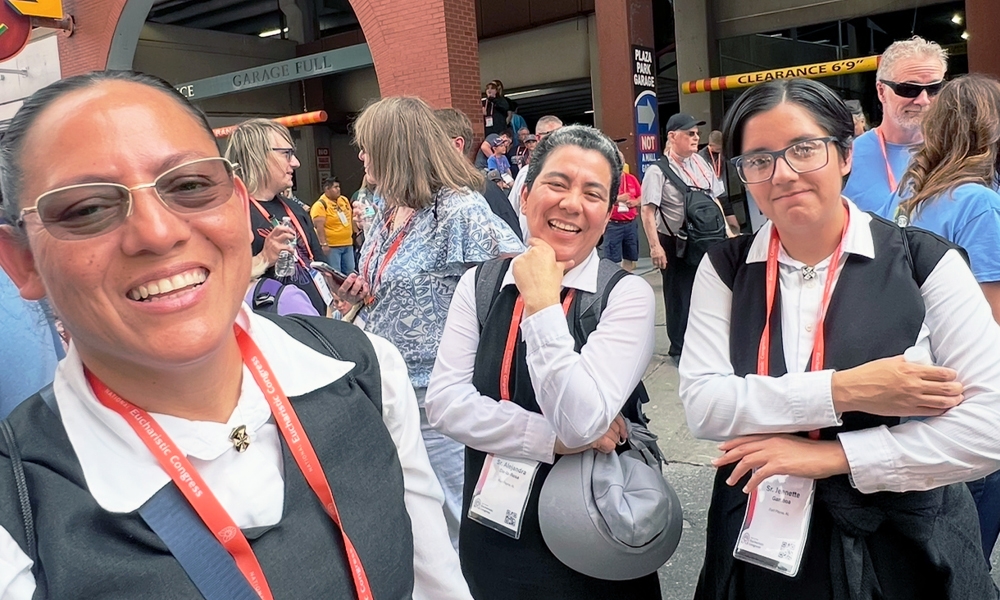
Surprisingly, the congregation has a connection to the Diocese of Birmingham. Father Rick Chenault, pastor of Our Lady of the Valley Catholic Church in Fort Payne, saw a need to evangelize and catechize the youth of his parish’s large Hispanic population. After being informed of the Catholic Extension Society’s Sisters Exchange Program, several sisters visited the parish. Realizing the parish would be a “good fit,” the congregation sent Dominican Sisters Iraís Santiago Santos, Jeanette Mireya Gamboa, and Alejandra de la Rosa Sifuentes to the rural Alabama parish in late 2023. During their five-year stay, Sisters Santos and Gamboa are pursuing degrees from St. Mary’s University of Minnesota to better equip them to serve the faithful in the future.
To learn more about the Dominican Sisters of Christian Doctrine, please visit dominicasddcnorteamerica.org.